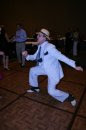
BRUUUUUUUUCE!!
The Boss and the "booty shakin' history-makin'" E-Street Band,
Richmond Coliseum, August 18, 2008
 Bruce Springsteen performs at The Coliseum. Photo By: JOE MAHONEY/TIMES-DISPATCH
In this Olympic season, the analogy is an easy one: if medals could be given for rock concerts, the band would get the gold, the venue wouldn't even take the bronze. Maybe lead, if such a thing existed.
Suffice to say, billion-eyed audience, this was an amazing show that blended all the better elements of the genre except for the freaking dreadful sound at the Coliseum. But for the true believers, none of this matters. They know all the words, anyway.
All those waving hands! And Bruce at one point turning into a sweaty preacher, invoking us to get into the spirit, and I thought with detachment that here the political, spiritual and entertainment all blur, as these days, that is what they've become.
Guy de Bord occurred to me, and I wondered, can a famous man be famous and still be a man? De Bord didn't think so; though he developed an illness related from his alcoholism and killed himself. I don't think Bruce would ever isolate himself in a cabin to write Situationist screeds. I know little of this biography, and I'm sure--since he is something of a poet--that he has his darknesses and moods. But why go off into a scholar's hermitage to kvetch about the utter injustice of life in the world when you're a brand as recognizable as jeans and Coke? Sulking isn't fun.
Yes, Bruce Springsteen is flesh and blood--he sweats buckets--but his art, conducted as his better lights have guided him, have allowed our popular culture to reward him with great wealth and access. He is the fulfillment and embodiment of his audience's hopes and dreams; a poet, a protean and erotic force, a Dionysian hero.
****************************************************************
In a sense, he is one of the last great entertainers -- his success has not destroyed him as it has so many others, but behind the quasar of fame and associations--Esquire Magazine putting him on the cover as an icon with a halo a few years ago--where is the person?
Slate writer Stephen Metcalf, in 2005, observed:
"...Springsteen is no longer a musician. He's a belief system. And, like any belief system worth its salt, he brooks no in-between. You're either in or you're out. This has solidified Bruce's standing with his base, for whom he remains a god of total rock authenticity. But it's killed him with everyone else. To a legion of devout nonbelievers—they're not saying Bruuuce, they're booing—Bruce is more a phenomenon akin to Dianetics or Tinkerbell than "the new Dylan," as the Columbia Records promotions machine once hyped him. And so we've reached a strange juncture. About America's last rock star, it's either Pentecostal enthusiasm or total disdain."
(You can read Metcalf's Faux Americana: Why I Still Love Bruce Springsteen, here.)
Or as A.O. Scott assayed Springsteen for the New York Times in 2005:
"John Lennon sang that a working-class hero was something to be. In England, maybe, but in this country, where money and mobility tend to dissolve and to mystify social divisions, a working-class hero may be a contradiction in terms. And so Springsteen, the son of a bus driver and a legal secretary, occasionally encounters suspicion when, from his current position as an unimaginably rich and successful rock star, he speaks up for, and in the voices of, the marginal and the downtrodden. His preacherly demeanor solicits accusations of bad faith, while his forays into political activism (including his mini-tour in support of John Kerry near the end of last year's presidential campaign) can be caricatured as the well-meaning sentiments of yet another wealthy show-business liberal. Springsteen's sincerity can also rankle those who prefer their pop culture affectless and ironical, or who are more attuned to the clever manipulation of sampled bric-a-brac than to the struggle for mastery over historical influences."
You can get it all here.
What occurs to me is that a compelling team-up, either for a print interview, or one of those Iconoclasts higher-brow reality shows, is to put Springsteen in with writer William T. Vollmann. Vollmann, who is married with a daughter, early this year came out with his ruminations about hopping box cars, Riding Towards Everywhere. His cross-country hoboing wasn't done in some wild Guthrie-esque college adventure, but for this book. Or his contemplations about the activity turned into a book. Writer J.R. Moehringer says:
"The man is miserable. The man is filled with irredeemable gloom about the state of the world. Many of us are filled with irredeemable gloom about the state of the world, but not like Vollmann. So bummed out is he that only one thing gives him relief. Being a bum. A transient. We're talking full-on hobo here...Vollmann doesn't care where the trains go. He rides from Wyoming to Idaho, up and down California, here and there in Utah, giving little forethought to where he'll jump off or how he'll get back. He catches out (hobo talk for train hopping) with only a backpack of meager rations (water, whiskey, chocolate, cowboy jerky) and an orange bucket in which to relieve himself. He has no ticket, no credit card, no cellphone and frankly no real purpose, which is ultimately the fatal flaw of "Riding Toward Everywhere," his earnest, diverting and baffling new book about life on the rails."
And:
"..."Riding Toward Everywhere" bears all the water-marks of Vollmannism. The absence of quotation marks. The fondness for footnotes and endnotes. The preoccupation with squalor. Vollmann is an avid student of squalor, a Rhodes scholar of squalor, and thus this book also features an ensemble of demented waysiders, ceaseless transcriptions of loathsome graffiti - and the requisite references to prostitution. Whores are to Vollmann as bears are to John Irving. Early on, Vollmann mentions "a Cambodian whore" he nearly married. Why? No reason. He also complains about having to borrow cars to cruise his local red-light district, because men caught soliciting have their cars impounded. This has nothing to do with trains. It mainly serves to remind us we've entered Vollmann's world. Love for sale, 24-7.
I don't know if it's a prostitute, per se, with whom Vollmann makes out near the end of this book. I'm not sure it matters, except maybe to Mrs. Vollmann. He encounters his anonymous inamorata near some tracks, "very high . . . dancing alone by her campfire," an umbrella poking out of her grocery cart - what guy wouldn't be turned on? He kisses her, and kisses her some more. The episode is so freaky, so out there, you later wonder if you actually read it or nodded off and dreamed it." The review is here. I've not read the book; but sounds reminiscent of Henry Miller's proto-Kerouacian journey cross-country by car, The Air Conditioned Nightmare. Like Vollmann's book, Miller has photoraphs, and he also enjoys squalor and sex.
***************************************************************************
We saw Bruce & Co. in Charlottesville on April 30 and while Springsteen gave his customary 175 percent, an elegiac tone could not be overcome. Just a few weeks prior, Bruce's long-time keyboardist and friend Danny Federici had died (April 17), of melanoma. See Bruce's eulogy, here. That concert opened with a somber tribute accompanying a photo montage on the big screens.
Amie's history with Bruce goes way back. She helped book him and the E-Street Band at Mississippi State in Starkville (his chronology dates this as 2/13/1981.) Bruce and the band performed for hours, though he was ill. Clarence Clemons remarked to a friend of Amie's that this was the first time during their touring that he'd seen a black girl on the front row.
Amie was with the Music Makers organization that brought acts in and she, somewhere, still has the backstage pass Springsteen signed. But when he exited the auditorium he left behind the hat or cap he was wearing and Amie, standing there with it in her hand, was faced with a choice: run to his bus, or....
The decision was made for her by the road manager who showed up, none too amused, and snatched away her True Article of Bruce.
Since being together, we've seen Bruce as just himself, sometimes with a few players. And the venues and the weather and moods weren't right. An earlier Richmond Coliseum show-- for "Devils and Dust"-- was on a raw rainy night, the place cold as a mausoleum and the space given poor apportionment, though we received a genuine treat of watching Bruce play a pedal organ.
Then there was the Charlottesville show.
Events move on, Norfolk, Va., native Clemons got married, and this Richmond show was momentous (and somewhat nostalgic, but for good reasons).
The city otherwise worked as it should. After a sunburning wave-buffeted day at the beach with colleagues at the office, I met Amie at the Fan house of our friends Ruth and Charlie, dined on plump, fresh shrimp brought up two days ago from South Carolina and prepared four different ways and mojitos.
We ditched our belongings, I showered and changed, and we dashed for a GRTC bus that got us downtown by 7:30 p.m. (Even though the bus driver couldn't say where to best get off for the Coliseum was, "I just drive," he said. Note to GRTC and Tourism: You really need to give your drivers some basic city knowledge -- this isn't the first time for me, or that I've overheard a driver profess total ignorance of the location of important landmarks. They also don't ever seem to know what bus is coming behind them. I hope with the new control center and GPS tracking this'll get resolved).
At the Coliseum we sat for an hour while the place filled up, our friend Katherine responding to Amie's urgent call got a scalper ticket and we watched her clamber around on the second tier with her young son. Then we learned we were in the wrong section and had to move down.
Still, excellent seats (thank you Michael, Amie's Music Maker advisor and concert impresario today). So we had the Springsteen E-Street Band Experience. The Boss threw himself into the audience and flung across the stage on his knees in a maneuver I saw in Charlottesville and reminds me of Roy Scheider as Joel Gideon in the finale of All That Jazz ; and at one point bent backward on his knees that must be the result of many hours of yoga or Plates. During a later song he slumped in front of the mike on the stage like puppet whose strings were cut, for one of the more introspective tunes. If he's not the hardest working man in show business, I really want to see who the other man is.
 He ran all over the stage, and up stairs to a catwalk behind him, pointing and acknowledging the cheap seats; one received the impression that if he could've, Springsteen would've run down every aisle and to shake all our hands.
The big screens mounted above the alter-like stage made the experience seem more intimate than it was; still, having seen him a few times, I can attest that Springsteen is one of those performers who shrink a massive venue to his own size, or rather, he and the E-Street Band fill the hall with his energy. The image here is from Sharif Ewees, via Facebook.
Max Weinberg played drums, as Amie says, without seeming to break a sweat (though when the camera cut to him during "Born To Run" I thought he looked a little fatigued -- he is, well, human, not bionic); Nils Lofgren provided masterful riffs; Steven van Zandt had just one solo on one line and that showed his voice was great; The Big Man blew, and not a weak player in the line up. I missed seeing Patti, just because I don't know when if ever he and the E-Street band will do something like this again. What can I say? I like red heads. And so does Bruce. He even married one. "But you ain't lived until you've got your tires rotated by a red-headed woman."
Who knows if Bruce might just in his later years turn into a folk duo with his wife and show up under assumed names and play A Prairie Home Companion.
Still and all, Soozie Tyrell was quite fine.
Prior to his barn storming "Living In The Future" he gave a political commentary--some fans like when he does this, others could care less. After eight years of feeling the need to say something, I bet Springsteen is tired of the remarks, too. But out of the 16,000 people gathered there, my guess is several thousand of them felt that, here, too, he was speaking for them. In 32L, this was the case, judging from the arms upraised screaming.
One of the signs he plucked from the crowd was one that pleaded that he do "Back Streets" because the person's band had just broken up. Whereupon they launched into a ripping, thundering version of the song. This event probably earned the sign-writer drinks for the next three months and I hope he or somebody he knew had a video phone to record the occurrence. "It's really hard when your band breaks up," Springsteen mused afterward.
Of course, I want to know -- who was the person, what was the band? If this were a story, or a film, that would be the climactic scene, meaning he band would either get back together, or transform into another one.
Got out, back on the bus and running into acquaintances which is the great part of public transportation, thence returning Ruth and Charlie's to retrieve stuff, and where we drank martinis on the back roof of their house reached by a narrow stair and dormer hatchway, under an almost full moon and basking in a wafting breeze from the south, and surrounded by the stage-set like backdrop of silhouettes of turrets and finials, the nearby Lee Monument and the Stuart Circle Apartments and the former Shenandoah Apartments. Then home at 3 a.m, ears ringing, and Bruce still singing in our heads, as he is now.
Full review from Backstreets, the official Springsteenophile house organ, and from the Richmond Times-Dispatch.
You can find a compilation of Springsteen concerts in Richmond from 1969 to 2005, many entries with set lists, at Handful of Brains.
Set list:
Tenth Avenue Freeze-Out
Radio Nowhere
Out in The Street
Prove it All Night
Lonesome Day
Spirit in The Night
Stand On It
Cadillac Ranch
Backstreets
For You (solo piano)
Youngstown
Murder Incorporated
She's The One
Livin' in The Future
Mary's Place
I'll Work For Your Love
The Rising
Last To Die
Long Walk Home
Badlands
-
Crush on you
Quarter to Three
Born To Run
Rosalita (Come Out Tonight)
Bobby Jean
Dancing in The Dark
American Land
Twist & Shout +
+ con / with Robbin Thompson
Labels: A.O. Scott, Bruce Springsteen, Clarence Clemons, Danny Frederici, E-Street Band, GRTC, Guy De Bord, Henry Miller, Joel Gideon, Richmond Coliseum, Situationist, Stephn Metcalf, William T. Vollmann
posted by HEK @ 6:38 AM
1 comments