The Blue Raccoon

Saturday, September 06, 2008

Illumination of Broad Street
Art and Imagination Reclaim Downtown


The parade of Wearable Art down Broad Street, as recorded by photographer Jay Paul.
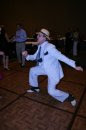
This is model Rickita McKinty with designer Kevin Blow in his design, "Untitled: Optica." The outfit includes 33 eyes with lights in their pupils and ostrich feathers.

I haven't seen much pop up blog-wise or in the regular media about what was a historic event--or rather, one of a series of them this past year on Broad--more discussion of Rodney Monroe and the rain. Well, that's too bad. Even Sissy Spacek was there.

My bias is obvious, because I emceed the Wearable Art component of the evening, (with at times less grace than I would've wished), but, apparently this caused no untoward distress. At least I hope so.

Yes, there was rain in the early hours but it cleared off and during the 9:00 to 11:00 stretch the street filled up, the video and audio projections on the walls went on, the Hot 8 Brass played and a man-powered contraption designed to project the spirit into the sky lumbered around. Every gallery was open and some very fine art on display-and will remain so for the rest of the month, and some longer--and would be a credit to any other city, of a greater population.

I stood at the center stage with Jake Crocker at one point when we took in the fanning search lights--for once not indicating the location of a strip bar--the glowing columns of light, the bright pools of activity along the street, the whirling psychedelic patterns on the trees, the great knots of crowds--and he said, "This is like some huge, outdoor Vegas club."

For a massive, first-time event, held when weather conditions threatened to wash out the whole production, InLight Richmond went well as we might've expected.

There's many thoughts and observations I have about this spectacular but time presses.

Here's the bottom line take away we should have, though. Events like InLight, First Friday and Broad Appétite are transforming Broad, its wide ungainliness, its semi-charming, semi-off-putting grittiness. Add in the Folk Festival, the proliferation of markets, and the other street festivals all over town, Richmond is reclaiming its public spaces.

This is an historic transformation. From the latter 19th century and more than halfway into the 20th century, Richmonders divided Broad right along the streetcar tracks; the "bad" north side, with its saloons, vaudeville and burlesque houses, nickelodeons, motion picture and legitimate theaters. Behind them, were Jackson Ward and Navy Hill, predominant black neighborhoods. The "south" or good side was where the major retail bustled, and the colossi of Miller & Rhoads and Thalhimer's. Of course, further east, down in Shockoe, form 1905 to about 1920, on Council Chamber Hill and into Shockoe Valley, was the tenderloin and immigrant tenements.

But like many U.S. cities, the vibrant retail center came to an end in the 1980s, and Richmond has struggled like others to redefine what this corridor can now mean to its citizens. The most successful responses have come from the entrepreneurs, the artists, and the makers and creators. Almost every public-private effort has failed or been mired in over-spending, planning mishaps and outright corruption.

Seeds grow where they are planted. Whether 1708 Gallery or Gallery5 on or near Broad, or Plant Zero in Manhester south of the river, they've been followed by restaurants, lofts, apartments, coffee shops and boutiques. What Richmond now needs downtown is a large grocery, or even department store--a regional based, original Big Store. Where'd you put it now, though, is a tough question.

Now, I'm not saying one event is a cure-all, but the momentum built by several of them creates a cumulative effect. And I've not heard much mention of this by any of the mayoral candidates. I don't understand why; except that the people are (almost) always ahead of the leaders. Whether a candidate was present during the evening, I do not know; there was a Mark Warner for Senate event at Quirk, though. Otherwise, I saw some of those Get Out The Vote petitioners, but no city job seeker out on the hustings. Kind of disappointing, if this was the actual case. Where are these people?

The production team that dismantled the Monroe and Broad stage, due to rain, then put together again and set up the sound and lights--those guys were some of the true heroes of the night.

Meanwhile, I danced with an Art Cheerleader to the cheering of a crowd, watched a beautiful woman in an 1830s style garment shoot flames, and experienced my Partner In Art For Life's video creation get projected on two brick walls.

As I stood there and watched the procession of models moving in their often confining creations and confections--including this marvelous Klimt-in-motion with a headdress of antler-like branches adorned with glowing lanterns-- I marveled. The Klimt had some trouble getting up the stairs--the branches got in the way of the handrails--and this true living work of art--needed to be assisted in her ascension.

This was a metaphor of Richmond's possibilities, and how often the biggest thing that gets in her way is herself. She just needs a little help, sometimes, to get unstuck and moving.

I ended my evening on a WoBSoC front porch railing, yakking with Mark Holmberg about Blue Shingles.

It just doesn't get much better.

More later.


Labels: , , , , , , , , ,

Sunday, July 13, 2008

What have we learned?
A compendium of odds and ends from the past few days

1)
Up front on the GRTC buses here in Richmond, Vee-a, there is a coffee can-sized brushed metal square container fitted with a prominent lock. When I was paying my fare a few mornings ago, the coin slot was clogged. The driver instructed me to use the jam box.

Jam box, is what the proper name for that object on the bus.

Please, billion-eyed audience, have a snicker on me. Say it slow and in a low voice...jaaam-box. Oh, yeah. A prurient mind is at feast forever.

2) Artist Bruce Conner died this past Monday. I have seen just a couple of his films, but I remember them; this was in 2002 at the James River Festival of the Moving Image among a sampling from the New York City Anthology of Films Archive of Essential Cinema. This was the program in which I was introduced to the luminous and brilliant Maya Deren, too. The Conner piece was Movie. [Image: Ken Hopson from the James River Festival site, link above. That's my very own Firehouse Theatre.]

This is hodge podge assortment of odd clips from various movies, interpolated by atomic age anxiety. The relevance and the freshness of the film, not to mention its influence, made the viewing experience one of those times when the original seemed a derivative. I must've seen his meta-reaction to the Kennedy assassination, Report, too, at one of the James River festivals, but I cannot recall which year, and Google won't drill that far. And Conner instructed that his films not be shown online. So I can't provide any links, as you can see from the first one in this graph.

I read in Conner's New York Times obit that a surreal montage sequence in the great Marx Brothers film Duck Soup inspired him.

"There’s a war going on,” he explained to an interviewer in 1976, “and Groucho tells Harpo that we need help, and he runs out and puts a ‘Help Wanted’ sign on the front of the building.Then you start seeing all these tanks, and airplanes, and soldiers, and porpoises, and giraffes — I don’t know — all sorts of creatures and things rushing to help them.” He added, “After that I started thinking about all the things I could stick together in a sequence like that: elephants running, trains blowing up, cars going, cars crashing, and so on and so forth.”

The Surrealists were impressed by this strange funny film; Harpo's rigorous silence that causes him to resort to auto horns and whistels, his anarchic wielding of scissors, and a trenchcoat that contained anything he needed, a dog house tattoo that when Groucho inspects it, sprouts a live barking dog; the running gag of the motorcycle sidecar taking off with Harpo and Groucho, thinking this was his time to roar off, sitting glum and observing, "This is the third trip I've made today and I haven't been anyhere yet" ; a council of war becomes a production number and soliders' helmets are used as a xylophone. Salvador Dali prepared a script for the Marxes. [Duck Soup image from central cinema]

Duck Soup is also the inspiration for Woody Allen's character in Hannah and Her Sisters, and reason for him not to commit suicide.

Conner was one of the last Beats, and a artist who pursued his bliss, and the world is richer for his creative method of living.

3) The Richmond Triangle Players here have moved into a sleek, splendid mid-century modern brick building I've admired at Altamont and Marshall. The slanted window and metal overhang of the front office has always reminded me of an airport control tower. The collection of buildings were until of late Carl's Radiator Service. Now Triangle will have its own digs, scene shop and more seating. Bravo!

4) William Shatner is in Judgment At Nuremburg. He is young, and probably about the time he was in that famous Twilight Zone where he sees the gremlin on the wing of the airplane and goes crazy trying to tell the pilot.

Seeing him there, though, gave me a kind of vertigo. I swear, it was like a Star Trek third season episode where for some reason Kirk has traveled in time. I really half-expected him to flip open a communicator.

And, too, all the amazing actors whom he was moving around...most of them are dead. Marlene Dietrich, Judy Garland, Montgomery Clift, Spencer Tracy, Burt Lancaster, Richard Widmark -- all gone. I think Maximillian Schell may be one of the few who are still living. And there's Shatner, and I see him on TV still cranking along and doing Price Line commercials. That must be a weird...sensation, to be Shatner, and to have that historic film on your resume.

Thanks to soundtrackcollector for the image.

5) Sometimes vigilance for the sake of consumers is a bad thing. This past weekend, my Partner In Art was teaching at the Virginia Museum. She's got a bum ankle these days and I helped her carry her bag there and back, and fetched lunch from a lunch-fetching place in Carytown. Well, due to my own absent-mindedness, I left my debit card on the counter there. I was gone probably under an hour when I realized that I'd done this to myself -- again -- and dashed over to the establishment in question. Well, the clerk there told me that he'd called the bank and destroyed the card. And on top of everything, my food order was wrong.

The clerk was acting in my own best interest, of course, but he must've thought I was a West End auslander or even a tourist -- and I wasn't even wearing Bermuda shorts with socks. I called my financial institution and they were confused aboout the diligence of the clerk, "I used to work in retail," my client representative said--in plain non-call center-tinged English, "and when that happened, we used to hold on to them for at least a day."

Fact is, I needed a new card--the security numbers on the back had faded to the extent they were impossible to decipher, and a slight bend in one side sometimes made the plastic unreadable to account-deducting devices.

But it is an inconvenience that I should've been spared. Why they couldn't try to have the bank call me, or they call me, or somebody call me, I don't know.

6) My comments to some Richmond, Virginia, blogs are "long-winded." One described a historical context response as reminiscent of a monologue from American Psycho and I think he meant this in a good way; still, this kind of hurt. Sigh.

7) Writing takes a toll on one's body. This is in the especial case of logging 10-15 hours in a chair and going full bore. The form hunches, shoulders bend in, my right hand has swollen, my left knee, too. I'm on deadline for a manuscript and this is what it's doing to me, or what I'm doing to myself, in a forced march through the quagmire of historic references. By now, my work, my wife and the editors of the publishing house are all ready for this damned thing to be done.

Adon Yoder is chuckling somewhere. I was surprised to find him mentioned in this wayback Time Magazine article.

8) Anhueser-Busch is now owned by Belgians. The Chrysler Building was in recent days sold to German investors. I remember even back in 1989 when the purchase of the bankrupt Rockefeller Center by Japanese interests struck me as odd. They sold about 10 years later, and appropriate enough, today U.S. capitalists own the Rock -- which is becoming more the exception these days, than the rule.

This past week, my nose was purchased by a 13-year-old Alsatian girl with Euros saved from her baby sitting job. My breathing has not been affected by this transfer and no changes to the nose are planned. Or that's what Giselle has told me.

9) I stumbled cross this image on the Interwebs while looking for something else. This came from a memorial site for the Birney company streetcars, and this, billion-eyed audience, hit my eyes like cymbal-crash. It's Broad Street looking west from about Fifth Street. The building looming at left is Thalhimer's and, of course, next to it in sharp foreshortening, Miller & Rhoad's, the retail collosi of Richmond. The office tower in the background is the Central National Bank building. I cannot see if the famous neon letters that turned either blue or red depending ont the cold or hot weather are there; the contrast and glare is too bad.

Note the clustering of stores on the right hand stores. One atop a roof is for the Wakefield Grill, 3124 W. Broad St. -- which is up the street a number of blocks, beyond the Boulevard.

The time, judging from the clothes and cars, seems to me a cold gray day in the mid-1940s, and that streetcar doesn't have much longer to run since the service was suspended just when we could've modernized it and retained the benefits, in 1949.

Little did any of these people know but that the city was on the verge of precipitous decline, that the suburban sprawl that had began with the streetcars in the 1910s was undergoing fatal acceleration by the auto and cheap gas, low mortgages and demand pent up by first the Depression, then the war, for cars and Cape Cods and brick ranchers, during a wildly over-prosperous period due to the rest of the world being bombed into a temporary halt (which the U.S. helped restart). Then, race and class in Richmond, and digging highways through the middle of town over public protest, made a scene like this even less possible to maintain.


Here's a detail of the signs and storefronts on the right side of the street. I've heard of Grant Drugs, but I'd have to hunt in the city directory to know if that big clock went with the store beneath, or was advertising something else.


10) Thanks to the West of Boulevard blog, I know that the ABC store up on Thompson Street will now be open Sundays. Economy tanks, people drink more, and the state--which both sells and taxes the stuff--will benefit. Now, I don't have to wait until Monday to get my Bushmill. Which I can't purchase, anyway, because of what happened to to my debit card (see #5),

Labels: , , , , , , , , , , , ,