The Blue Raccoon

Thursday, September 03, 2009

The Girls Are Back --
Is There Going To Be Trouble?


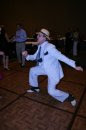
Yes, billion-eyed audience, here they are again. Many of you long-time listeners already know the story. But, for those of you who don't: this image was taken, and not by me, at an exhibition opening several years ago at the vanished
Three Miles Gallery and this space, and the adjacent one, is today the bustling Tarrant's Café.

Richmond's First Fridays Aftwalk begins its new season in earnest tomorrow evening. You can see it all in colour here. Here at the Blue Raccoon, these young women are emblematic of the social verve and creative energy -- a Dyonisian jumbalaya, well, not in the radical True Blood way -- that First Friday Richmond represents in ye olde Richmond Towne.

This pair of Richmond lovelies display the classic duality of Greek tragedy/comedy, and the predicament of existence, and how in general conditions are one or the other -- depending who you are and where your viewing booth is.


But is the representation of enjoyment that seems to unnerve some people. Or at least, after eight years, suddenly the civil administration here gives the appearance, anyway, of being shocked, shocked! to see art galleries on Broad Street, and droves of people trooping in and out of them. This, too, is reflected by the haranguing of corner preachers on milk crates with PA systems who are persuaded that wine and cheese are the gateway drugs to hell.

The fear and anxiety was portrayed in the current issue of the city's weekly tab.

As often happens, the comment train following the article is more illuminating - and for bad reasons -- than the article. Like a particularly bad morning on C-SPAN, the snipes and quips aren't so much directed at the issues raised but bent on grinding particular axes or slapping around artists, whom even in 2009 in Richmond are viewed with suspicion as potential subversives and condemned as useless drains. Never mind that without the arts schools and institutions devoted to them here that Richmond would just be another whistle stop on the way to Atlanta. I'm beyond fed up with people who a) Don't read articles all the way through and b) Comment with knee-jerk responses to a headline, picture or captions. This is why we as a civilization in decline: lack both attention and discipline. So there, corner preacher, stick that up your righteous indignation.

And so there are belligerent, bullet-headed nihilist hipsters who'll profusely and obscenely decry Richmond as some kind of portal to, I don't know, boredom or hell or hellish boredom but that's because they insist on wanting Richmond to be New York or L.A., or any other place that it is not. Let Richmond be Richmond, and if you're not willing to roll up your sleeves, expose your baroquely tatted forearms and do something constructive, then why are you here anyway? In a way, these types are just as annoying as that street corner preacher who is just there because he likes to hear himself preach or the suburbanites who, from the safe distance of the cul-de-sac, toss their grenades of ignorance and fear. And their shrapnel unfortunately sticks in all of us.

Which gets me to the presence of uniformed officialdom that was meandering among the galleries during August's First Friday, with their clipboards, clickable pens and curious expressions. I understand the need to monitor safety regulations for buildings, without question.

However, there is a way to do things. Can we not go to the spaces and look at them before they are packed with people to see about proper egress and lighted exits and such? You do want to see them under the times of most stress, too -- and that doesn't make city officials bad guys, but, there should be a better, less invasive way.

So. I guess we'll see.

Some of the highlights I intend to hit:

Little Creatures, a 1708 Gallery satellite exhibit at the historic Linden Row Inn and curated by my personal Grand Louvre, Amie Oliver. The show features sculpture, painting, drawing and photography inspired by animals and the natural world.

For more information on the artists please visit the links below:

Joan Gaustad:
http://www.adagallery.com/Joan_Gaustad.html

Leah Jacobson:
http://www.leahjacobson.com/

Rob McAdams:
http://www.supporttrike.com

Jamie Pocklington:
http://www.jpock.com

Gordon Stettinius:
http://www.eyecaramba.com

Rob Tarbell:
http://robtarbell.com

Paul Teeples:
http://1708gallery.blogspot.com

Another show I've quite desirous of seeing is Thomas van Auken's exhibition, sponsored by Art 180, at the Schindler Satellite Gallery at 8 W. Broad.

I snagged this image from van Auken's Facebook. I enjoy his confident lines and Germanic textures. Figurative work has had its ups and downs in terms of general acceptance these days. VCU tends toward the Abstract-Expressionsits, and around the country, drawing itself isn't considered as important.

So it's great to see somebody who somehow not only learned to draw but paints, too, and the overall effects are pleasing and even sometimes a bit startling.

I'll be buzzing into Ghostprint, Gallery5, and Metro Space Gallery, too.


I'll see you on Broad or nearby, on Friday.

We shall return to Phil Gotz's tour of Richmond during the weekend.


Labels: , , , , , , , , , ,

Tuesday, September 09, 2008

Reflections From InLight


Current national events are to the point where they weary me to speak of them, or write an opinion few will read, and half of the billion-eyed reader will contest as misled at best and false at worst. So. I'm retreating today to pictures of a marvelous reent evening.

These are images from InLight Richmond, produced by the 30-year-old 1708 Gallery and the Wearable Art component co-sponsored by The Phoenix of Carytown. This post's pictures are from photographers Jay Paul and Amie Oliver and constitute a mere sampling.

The top image and the following two are from Jay Paul.

Klimt brought to life...Designer Julien Archer created this piece that translated out of German was "The Witch's Woods" and worn here by the statuesque Ann Marshall -- whose poise and stunning facial bone structure-- and red hair--made this into an unknown Klimt.


Hot 8 gives us some of that NOLA vibe...


Amie Oliver:


Harry and Da Goilz...


Harry gets his soul projected
into the heavens...


and the ghost of a Jackson Ward house by London architect Peter Culley, in collaboration with lighting designer Eleni Savvidou. This was a life-size, architectural 3-D "light drawing." Savvidou is a lighting designer with L'Obervatoire in New York, Culley the project director for the ongoing expansion of the Virginia Museum of Fine Arts...see more here.


Amie Oliver on the wall...


Torches and banners either protesting or in favor of nothingness...


Labels: , , , , ,

Monday, June 09, 2008

Smokin' Hot In Richmond
A weekend of heat, history and physical and technical mishaps


Billion-eyed audience, little time and too much to tell, really.

First, the BBC site which is my Internet home page has become so glitchy that none of my browsers can bring it up, nor can I alter it in Preferences. HAAAAALP!

Second, I have a scratched right knee, a wrenched ankle and until this morning a bent temple on my glasses. All were unrelated and occurred while I was sober. The knee injury occurred when I slid down the side of my porch while wresting vines creeping across the living room window. The ankle got twisted while walking along in Carytown alongside Double-T's along. This patch has some uneven spots and I think while momentarily distracted I brought my foot down onto what I thought was an even place, but it was depression instead, and OOOFFF, there I went. The glasses got bent when I fell asleep watching Knocked Up.

Third, the weather here has gone from balmy to brutal. Friday we even had smoke pumped up here from an East Carolina forest fire that draped gauzy clouds across the region, and the mercury's rise mirrored the price of gas.

On Colonial Avenue, the cats splay their bodies against the wood floor in an effort to find some cool. I've had to turn on one of the air conditioners that we almost always refrain from until July, or later. But this is for humanitarian, and feline, relief.

The torpid temperture didn't stop the congregants of First Friday. The House of Praise brass band played near Art6 and that alone was worth the bus ride down. Between the heat and the festive character of the gathering, one couldn't help but feel transported to New Orleans. Except they are ours, and we are theirs.

I encountered artist Gillian H. Brown who has a small show upstairs in the Todd Hale rooms of her haunted, tormented and whimsical, funny acrylic-on-paper faces. You can see more of them on her blog, here. Gillian's the coolest, even in this unforgiving torrid zone. By the way, that's her, from her blog portrait.


Finally, I want to thank the Valentine Richmond History Center and Linda Krinsky and Bill, the bus driver, who guided my intrepid hard core history group around town and allowed me to preach before the the Christopher Newport Cross. I forgot my sure fire obscure laugh, "This marker has nothing to do with bearded balladeers who sung themes for Arthur movies." Four people would've gotten it out of the 50 and I would've loved this.

I also want to thank the Lady Susan who tied my bow tie, and surprised her husband of 30 years by knowing how to do so. You learn some things on these tours.

I can almost guarantee that I am the only history tour leader who marched his group in front of the Walnut Alley mural in Shockoe and regaled them with the story of Urban Artists Amalgamated, as recounted in True Richmond Stories. Or, as I referred to the slender volume, 'The greatest book of Richmond history published in October 2007 and republished in March 2008."

The heat further gummed up my synapses because people took pictures and I should've passed out cards and had them sent to me. Duh!

Amie and I spoke Sunday, she in Germany, me in the over warm breakfast nook with overhead fan whirring on Colonial Avenue. She kicked my butt about remembering to tell a story with Ragtime In Richmond. Which is about to rag me out.

I hope to figure out a way around this glitch on the BBC site; if I'm having this problem, I'm not the single one.

I leave you with some posts from James Howard Kunstler's blog. His peak oil-surburbs are crashing-world is ending tropes are consistent, and often eloquent, but in the end, the back-and-forth of the long, trailing comments are what keep me coming back. Of these, I really like montysano's take on the politics of the day.


I've been making book on how the U.S. public takes the coming financial Tidal Wave.

Homicial rage vs Suicidal Rage

Tough call.

Apathy will Not be a choice.

Just read an article (I'll try and find the link) on how many current and recent soldiers are on prozac and similiar drugs, just to cope on a daily basis.

Butt Boy Ben Bernanke should be dropping Prozac out of the helicopter, Not worthless Phunny Money from the Fed 'discount lending window'
Posted by: Lost Horizon | June 09, 2008 at 09:52 AM

Obama will probably be elected president, but if he does he will inherit the wind vis-á-vis Herbert Hoover in 1929 and we will have to wait four years for his successor—either a Democrat or a Republican or even a “Progressive Party” president—(e.g. Henry Wallace)— to start another World War after a similar eight years (1933 – 1941) as was the case with F.D.R., of failing to solve what will come to be seen by future historians as the Second Great Depression. For that reason alone I would have loved seeing Hilary [sic.] as Chief Executive.
Posted by: irahan | June 09, 2008 at 09:59 AM

John McCain can dodder and bumble around the country, without a new or original idea in his head. He does so with the baggage of an heiress wife with a fondness for pharmies, and with the putrid carcass of the Bush administration hung around his neck. And yet, at the end of the day, he still owns 40% or more of the vote. A country this stupid deserves whatever comes its way.
Posted by: montysano | June 09, 2008 at 10:07 AM

Kollatz response: Is it that the country is this stupid, or that we're prevented from having more than just two choices for its highest public office? As DeGaulle said of France, in a nation of 300 cheeses, how can we have just two political parties? I don't think this is as much stupidity as media narco-zation of our thought processes.
Bad habits are difficult to break, even when we know they are detrimental to us, because sacrificing what we regard as normal, means bringing some pain upon ourselves.

Anybody who thinks McLame is totally out of the race has not bothered to dig into the irregularities that occurred during the past 4 elections.

There was a greater statistical probability of having lightening destroy your winning lotto ticket before you could cash it in than there was of obtaining the Ohio 2004 results.

Despite reams of solid, testable data, and a juicy story rife with drama, nary a peep was heard from the Main Stream Media.

And so America will get what it deserves.

And remember to try and act surprised when, against all polling, a McLame victory is plucked from the statistical noise.
Posted by: MaryW | June 09, 2008 at 12:07 PM

Kollatz response: Well, I hope for our sake Mary is wrong. But my fear is, should Obama win, he'll be Carterized or Hoovered by events and poor advice. In a way, maybe for his sake, having McCain left with this rasher of scheit is preferable and perhaps poetic justice.

The Great Deleveraging of the 00's is well underway. (What the heck do we call this decade anyway?) Just read the carnage over at the housing bubble blog (the weekly "local observations" column & commentary is pretty good) and you'll see how fast things are swirling around the bowl...

According to the AAA/OPIS numbers, regular unleaded gasoline went up by 1.8c today to $4.023, and diesel went up 1.1c to $4.773. Diesel was in fact higher-priced at the end of May but had been recovering, while the gasoline price is a new record.

My neighbor's recently-purchased Yukon Denial XL hasn't moved since sometime last week. Besides the repairs it needs, it may have simply burned through the free tankful of gas included with the thing.
Posted by: Nudge | June 09, 2008 at 12:25 PM

Kollatz Responds: Should we call this the "The Aughts of Naught?" "The Awful Aughts."

Labels: , , , , , ,

Thursday, May 08, 2008

Art and Theater and Life
A good weekend to be in either in St. Augustine, Fla., or Richmond, Va.


St. Augustine is the nation's oldest continually occupied, European-settled city (founded by the Spanish in 1565 (!)); and also near Florida's beckoning summer beaches. Thus, it is right and appropriate that my partner-in-art-for-life, Amie Oliver, and our friend, Ruth Bolduan, should have an exhibition titled "Drawing From History" opening there and that their work features the figure and often historical or classical settings. And you have almost the entire season to get down there to the Dow Museum and see the show.


Unlike Amie's and Ruth's work, the Firehouse Cabaret is in its last days. For members of the billion-eyed audience who think in terms of a 2 million number possible audience and a rotating cycle of bus tours, it's Richmond, and a smaller market, and we're a strained shoe-string non-profit. That all said:

Last Two Weekends! "The Firehouse Theatre Cabaret"

Better than Botox!*

Does The Firehouse Cabaret , directed by and starring Scott Wichmann, have magical properties? Can you actually leave this show looking years younger? Can you afford not to find out?!

Read the stellar reviews below and make up your own mind! (Then buy some tickets!)

"The sort of program Richmond can use more of." - Mary Burruss, Style Weekly, in her review, "Snacking on Actors".

and

"Firehouse Theatre Project Courts Controversy With Latest Production" - S.E. Parker's interview with staff and cast in RVA Magazine.

Quick! You've only got until next Saturday, (the 17th) to see for yourself what the hubbub is about - and be seriously entertained in the process.


*not verified by scientific means.

Actin' up:
(top to bottom)Jude Fageas, Alia Bisharat, Lisa Kotula & Scott Wichmann Image by Jay Paul Photography

Special Events: See Firehouse Theatre Fire Ball auction winners Caroline Gottwald (Thursday, May 15) and Debbie Walton (Friday, May 15) onstage in The Cabaret!

Short on cash? No problem! Sunday, May 11 is "Pay What You Will" matinee day! Doors open at 3:30 for a 4 p.m. matinee. First come, first served!

Tickets & Showtimes:
General: $25, Seniors: $22.
Students $10 with valid ID. Click here to buy tickets online, or call the 24-hour ticket line at 1-800-595-4TIX (595-4849) Showtimes: 8:00 p.m. Thursdays - Saturdays. Sunday matinee at 4:00 p.m. Doors open a half-hour before showtime.


Readers Theatre is Back!
Readers Theatre, Tuesday, May 13th, 7:30 p.m. - Free. Kerrigan Sullivan directs John Tyler Community College students performing this scaled-back, staged reading of Baby with the Bathwater by playwright Christopher Durang.

Mother is a frustrated novelist; Father's an unemployed alcoholic; and Nanny's a warped Mary Poppins who gives Baby rattles of asbestos and Red Dye #2. Durang's wicked wit sheds light on our foibles and follies as no one else in theatre can.


Do You Know Where Your "UGG" Is?
Hey, we know times are tight, and you'd support us if you could. Fret no more, dear Firehouse friend - Ukrop's Golden Gift program is in full swing, and for the price of a postage stamp, you can support your favorite theatre.

Your UGG certificate is lolly-gagging around the foyer, or lurking in the home office, waiting to be useful, so help it find a home! Drop it in the mail by May 31 to:
Firehouse Theatre Project/UGG
1609 W. Broad Street
Richmond, VA 23220

Lazy friends? Rescue their UGG certificates from the recyle bin, and send them on, too! Thanks for your support!

About The Firehouse Theatre Project

The Firehouse Theatre Project, a non-profit theatre company, was founded in 1993 to present important contemporary American theatre pieces with an emphasis on plays not previously produced in the metropolitan Richmond area. The company, which is under the direction of Carol Piersol, Founding Artistic Director, is housed in the former Richmond Fire Station #10 at 1609 West Broad Street. For more information about the Firehouse Theatre Project's 2007/08 season, please call 804.355.2001 or visit the website.


The Firehouse Theatre Project
Stacie Birchett
Public Relations and Marketing
phone: 804-355-2001

And this wonderful piece from a concerned journalist, via RVA Magazine in which it is revealed all the actors keep their clothes on. Fort this show, anyway.:

Firehouse Theatre Project: Cabaret - S.E. Parker
Firehouse Theatre Project Courts Controversy With Latest Production

Actors Remain Fully Clothed in ‘Cabaret’

The fingernails of Founding Artistic Director Carol Piersol have seen better days. She's nervous, and despite her calm exterior, her hands betray her.

"This is the most normal show we've done in years at the Firehouse," she says, over a cup of chamomile tea and a scone in a popular Fan District coffee house. The tea calms her nerves, she says, and the scone is a guilty pleasure. "I knew we might offend some patrons by doing this kind of show, but it was a risk I was willing to take. I think our audience can handle it."

She's talking about The Firehouse Theatre Cabaret, an entertaining assemblage of ten-minute plays and songs, accompanied by jazz music that opened April 24th and runs through May 17th. Unlike the generally expected Firehouse plate of edgy, thought-provoking drama however, "The Cabaret" dishes up a night of pure, unadulterated pleasure. "There's absolutely nothing to think about afterwards," Piersol says, "and that might disappoint some long-time season-ticket holders. But I've seen


Labels: , , , , , , , , , , ,

Sunday, March 16, 2008

I've Just Been Busy
Birthdays, short stories, leaf sweeping, work, history, wondering if JPMorgan's purchase of Bear Stearns signals the collapse of the economy.


This is Amie and me at the New York Deli's photo booth during the wonderful observation of the annual anniversary of her birth this past week. I love photo booths. They are so retro, and you always look famous. In addition, I'm reminded both of Amélie and Paris, both of which Amie and I enjoyed in the recent past.

The weather here has been sunny, bright, breezy and a bit rainy in the evenings. I got some leaf sweeping accomplished during the weekend, from out of the stairwells to the basement. And the upright waste pan I use that saves untold suffering of my back fell apart during the process. My screws came loose.

The Late Henry Moss closed at the Firehouse Theatre Project and so goes an era at the company. This was Justin Dray's final performance on the Firehouse stage for the foreseeable future as he leaves this week for L.A. and director and actor Bill Patton returned to his new conjugal home in Maine. We were so happy to see our most civilized friends, the Cusacks, down from their home of about two years, near Boston.

I completed a short story and submitted it for a compilation volume; a day late, and not short, and perhaps not much of a story. We'll see. I wish I'd demonstrated some patience and gotten Amie to read the piece before I slung it through the cyber-aether.

At any rate, billion-eyed audience I'm a bit concerned--as many of you are, too , I wager-- about the financial future of the nation as today--Sunday--JP Morgan purchased the failing mortgage house Bear Stearns. I've navigated around various blogs from the sober probity of The Economist to the sassy libertarian (and pro-bankruptcy advocate, among many other things) Just A Girl In Shorts Shorts Talking About Whatever and I look forward to what Kunstler will make of the mess.

To quote Twofish:

"So what is happening is that the Federal Reserve is basically taking the role that would be played by bankruptcy court, it gave Bear-Stearns an emergency blood transfusion that could get it to the emergency room. This is quite unique and it is something that was done in the case of Long Term Capital Management. It’s really breaking new ground here, and what happens will be studied as a guide for what happens the next time this happens (which I hope will be a long, long time from now, but who knows).

One group that comes out of this looking really bad is CITIC Securities. JP Morgan ended up paying $200 million for all of Bear Stearns and total control, whereas CITIC was about to pay billions for ten (?) percent with no management control. It’s fortunate that the Chinese securities regulators failed to approve the deal otherwise, CITIC would have ended up burning $5 billion.

I think the one common thing that Spitzer, Tibet, and Bear-Stearns have in common is that it shows how quickly things can fall apart."

I watched Wolf Blitzer with U.S. Secretary of the Treasury Henry Paulson and all I could think of was this Saturday Night Live character from years ago; he was the Corporate Spokesman, who smoked, and sweated and got visibly more nervous as he was asked questions by a Weekend Update reporter, and his catch phrase was, "Did I say that? I don't recall saying that."

"Remain not only calm, but convivial."

As Tom Hanks admonished patrons at the Byrd Theatre last week during a power interruption, so seems the grey Establishment faces and Voices of Reason pertaining to the financial crisis. As of Monday prior to lunch, the joggled U.S. markets were actually rebounding, but concerns that this is but the beginning of something worse has curtailed outright optimism. Lehman Brothers could be on the ropes.

Steve Duncan, a poster commenting on Kunstler's blog, makes the laconic observation that,
"Market trading in positive numbers. Bear meltdown but a blip. I think if NASA scientists announced concrete proof the Earth was getting sucked into the Sun on April 1st there would be a 500 point rise in the Dow. There is seemingly no such thing as bad news. And what we think is bad news produces positive trading action. Go figger........"

And this pragmatic assessment from Tanqurena reacting to one of Kunstler's observations:

">In addition to the financing the Federal Reserve ordinarily provides through its Discount Window, the Fed will provide special financing in connection with this transaction. The Fed has agreed to fund up to $30 billion of Bear Stearns’ less liquid assets.

So. In this week's Rodney Dangerfield moment, the Fed had to tie a $30 Billion pork chop around Bear Stearns' neck to get JPM to play with them.

And to think that JPM only paid $236Million for that $30Billion pork chop (it is a non-recourse loan, which means the Fed can't go after JPM if they default on it). Ain't corporate welfare wonderful?"

By the way, Kunstlers's posting this a.m. "A Real Freak Out," is well-worth reading and until the comments deteriorate into flame throwing--why, boys and girls, why?--they, too, can provide insights.

I quote from Kunstler:

"Things are getting very weird very fast -- and will probably get even weirder, faster, as the train wreck of bad debt meets the Saint Paddy's Day Parade of bacchanalian excess at the grade-crossing of destiny. The train is carrying America's financial system, but the engine driving it is peak oil, because declining energy resources necessarily means declining capital wealth -- and declining value of all the institutions, instruments, and markers that denote that wealth or hope to profit by trading in it. The fiasco leads straight to the necessary reinvention of American life on other terms and by other means....

I'm sure our political leaders will mount a campaign to rescue the futureless infrastructure of suburbia. It will necessarily be an exercise in futility. But it has already started. That's what the swindle of ethanol has been all about. And the touting of hybrid cars, and the flimflam of "energy independence." Even the "environmental" crowd" squanders most of its attention these days on how to keep all the cars running on something other than gasoline. They don't question the assumption that we will remain a car-dependent society.

As much as I loathe the suburbs in their grotesque late-stage efflorescence, I can understand why those stuck in them would wish to defend their misinvestments. I just hate to think of the political consequences when their disappointment catches up to the reality that the suburbs will not be rescued. And by that I mean not just the houses but the way-of-life associated with them and all its accessories, furnishings, and activities. Bewilderment will soon turn to rage out in the highway-strip-and-cul-de-sac empire."

l love that phrase "grotesque late-stage efflorescence." Kunstler is all about the peak oil business and if you read him every week, his message of The End Is Near gets threadbare as the End's goalpoasts, that seem to be getting closer, are instead moved down the field a few more yards. Being a Jeremiah has its risks because you end up sounding like a crank, but doom and gloom provides odd comfort to those who see nothing but a collapsing civilization all around--much like that crane in New York, or tornadoes in Atlanta (see below).

Kunstler reminds me of Arthur Schopenhauer (1788-1860), whose philosophy hinged on how life is in the crapper and you just have to realize this without expecting events to get any better. He was a best seller, in his day. (And, by the way, I'm not saying either Schopenhauer or Kunstler are wrong.)

Schopenhauer, not content to the detail the depressing nature of things, gave his readers the following advice for-- not quite happiness, but emotional maintenance.

• Live in the present, making it as painless as possible.
• Make good use of the only thing we can control, our own minds.
• Our personality is central to our level of happiness.
• Set limits everywhere: limits on anger, desires, wealth and power. Limitations lead to something like happiness.
•Accept misfortunes: only dwell on them if we're responsible.
•Seek out solitude, other people rob us of our identities.
•Keep busy.

He sounds almost Zen here: desire is the root of all unhappiness, or even Existential: recognize life is meaningless and have a good time, whatever that means to you.

I don't know enough about Schopenhauer's views on whether art or creativity mattered in all this (I think the importance is paramount), and he seems to prefigured Sartre in Nausea: hell is other people. Which, by the way, I believe only a few days out of the year.

And by the way, Kunstler's next book is coming out. World Made By Hand: A Novel of the Post-Oil Future. Listening to the "trailer" (Books with trailers!) I am reminded of The Postman, that called up a post-oil world, too, and focused on bands of survivors and zealots. The subject seems less far fetched today than when David Brin's novel was published in 1982. That was a time of nuclear immolation fears, Reagan and the "Evil Empire." Those were far off, innocent days.

Cormac McCarthy's The Road of 2006 is even more grim; and is set in the immediate post-collapse of Everything, what Kunstler is also discussing.


From CNBC:

"There's turmoil in all markets after Bear Stearns, and equities is not the place to be," BNP Paribas strategist Edmund Shing told Reuters. "Everyone's asking: Who's next? Is there a Bear Stearns in Europe, could investment banks start to fail?"

The shock news, the biggest sign yet of how devastating the credit crisis is for Wall Street, slammed the U.S. dollar to a record low against the euro and boosted gold and low-risk bonds.

"The fear is how many more skeletons in the closet are still there in the global credit markets?" said David Cohen, economist at Action Economics in Singapore. "This is another effort by the Fed to calm things down, but the cloud on the horizon is just how much more of these credit issues are still out there."


Tornado Hits CNN -- World Stops Spinning


CNN all the sudden became the Weather Channel on Saturday as its varied correspondents went scrambling through a few blocks of blasted wreckage following the work of a tornado roaring through during the night.

[The image is via
Sansego's blog that has some other arresting images and good commentary. ]

We first heard the news on Colonial Avenue when Amie's dad, watching the SEC Tournament in progress on live television, observed how the Alabama v. Missississippi State matchup was interrupted when part of the Georgia Dome was ripped away.

At least three are known to have died--a low number considering the thousands who were concentrated in midtown Atlanta that night. Stilll, behind every statistic is a tragedy, and no less so than in Atlanta. Bonnie Turner, a protector of animals, was taken by this force of nature. Many of the animals she'd rescued were loosed into the storm.

According to CNN's Wynn Westmoreland, Mrs. Tyler left this quote on her Web site, www.flinthillkennel.com: "Beauty such as this is a gift, and I'm often in awe of this world we've been given."

In other news, as they say, a gigantic construction crane operating in east Manhattan collapsed, causing wreckage that looked like that wreaked by a tornado, and killing even more than than what natural forces took out of Atlanta-- maybe four died as the device smashed to the ground. The construction of a 43-story building had been cited for 13 safety violations, five of which were pending resolution. In Bloomberg's New York, if it isn't getting turned into a Starbuck's, then it's a high-priced condo. Hizzoner never met a developer he didn't like.


The Duty Patriot

So we watched the first two episodes of John Adams tonight. The program does convey the anarchic quality of revolutions--what with goaded massacres and crowds gone crazy. That any kind of Declaration of Independence came out of such a cauldron of emotions is amazing.

McCullough was right to point out in his remarks that the 18th century was not a simpler time. From disease to the whimsical rules of a tyrant, life's qualities were far more challenging. Still, one does wonder: thinking of Adams, Washington, Jefferson, Ben Franklin...where is such brilliance in the public sphere today?

The lonesome whistle of a train in the distance, and the lateness of the hour, and work in the morning, hastens me to bed.

Labels: , , , , , , , , , , ,

Friday, March 07, 2008


Hey Y'aa-aalll: It's First Friday


Yes, billion-eyed audience, if you've visited here often, you know what this image means: these two ladies, of opposing expressions but exuberant attitudes, shown here during a long ago opening at the defunct Three Miles Gallery which is now Tarrant's restaurant -- it's First Friday in Richmond.

The Weather Channel says' "Soon It's Gonna Rain" so, ladies, carry a bumbershoot and slip on a pair of cute but functional galoshes.

The printmakers (Southern Graphics Council) are coming to town, thus there's a number of galleries dedicated to one of the oldest, and newest, art forms. Check out Transmission's exhibition of the Women of Studio 23, and visit the gallery with the most appropriate name this month, Ghostprint.

Now, further uptown, actually in Uptown, as this strip of Ruchmun' styles itself, at the Red Door Gallery is work by five artists, including Amie Oliver, my partner-in-art, in an exhibition called Sugar and Spice. You have until the end of the month to see the work of these unique makers and creators.

Another Oliver, Rebecca Goldberg Oliver, has new paintings up at Gallery6. She's an Art Cheerleader, you know, and they won a Muse award last night at the Virginia Museum of Fine Arts. Gooooo- Art!


Another friend of the Blue Racccoon was celebrated in the Marble Hall; developer Tom Robinson, whose Vacant Spaces = Artful Spaces program makes waiting for the bus in midtown even more of an an aesthetic experience, and also provides attention for empty and neglected interwar storefronts. He's a caution, that Tom, as they used to say.


By the way, for those of you who've anxious about the second printing of True Richmond Stories, it'll be in the finer regional book shops as of March 28. If your Little Shop Around The Corner doesn't carry it by April, demand that the slender volume be stocked. Or -- you can go to Amazon.com.

Last night I spoke with a book group hosted by Katie at the "Dooley Mansion" and had a splended time. They didn't mind my three-cornered hat.

In other unrelated news, Charlie
Wilson's War
has arrived at the
Byrd Theatre. We're going.

Labels: , , , , , , , , ,

Sunday, January 20, 2008

More Notes About Art & Architecture
"Lost & Found" at Sol Cooper conclusion; Teresita Fernandez and Cece Cole at Reynolds Gallery; Rachel Flynn and The People's Masterplan and the Rage of the Élites.

"Lost and Found" broadside that demonstrates how these unique women also have variable approaches to their names, though she's Kathryn Purvis, not Catherine. Sol's people must've not heard the correct spelling through his Bluetooth headset.


This image by Amie Oliver captures work by all the participating Lost & Found artists; (left) Kate Duffy's The Night Has Only Grown Darker; Duffy's Untitled, 2008; Aimee Joyaux's Untitled S; Susann Whittier's kinetic Bird's Eye; and off to the right, Kathryn Purvis' Untitled I-IV.

All images via Amie Oliver.


Kate Duffy's The Night Only Grows Darker, which has the best title this side of a film noir classic, is comprised of a shipping crate, with acrylic, ink and enamel. In person, the piece has a quality of Japanese print (the water) and early wood block art--I'm thinking of those tombstone shapes--and the vocabulary of what's become called outsider art.


This is Amie's Deconstruction, with conte crayon, acrylic and wood puzzle parts she found in the alley behind our house. Or did I pick up the pieces some time ago? I don't remember. Together we find some curious finds.
Her Lost & Found work was so new, I'd not even seen the constructions, and was as surprised by them as a number of the visitors were. In a way, she's returned to a style of layering and texturing of materials that she was using when I first became acquainted with her work lo now some 12 years ago, but with revived energy and color. Plus, I always like that hat on her.

Susann Whittier's Bird's Eye is one of the exhibition's more intriguing pieces. This is a moving sculpture made of plaster, doll eyes, springs, wood and a motor that turns this surreal Ferris wheel as the lids of the eyes open as the proceed around and close as they return up. Visitors stood before Bird's Eye with a mixture of fascination and amusement. It's reminiscent of something out of Bunuel and The Twilight Zone.

Aimee Joyaux provided a quiet tour-de-force here with Steel Bouquet I-III placed upon big, old timbers. These look like dried flowers but are made of lead pipe, stell, copper, encaustic and oil. The shadows create twins for the arrangements.

This is Untitled IX in the delightful series Kathryn Purvis contributed to this exhibition. The elements are an oxidation-fired ceramic, seahorse, crystallized rock. The shapes remind me of both dogwood blossoms and doubloons, or other coins found in shipwrecks at the ocean's bottom.

And though not part of the exhibition, but participating in the general atmosphere in Petersburg that night, were the High Street Low Lifes that play old-time folk and rag-time pop music of a century ago, mixed with their interpretations of more contemporary music, and their own, too. This is plinky-plunky-kazooey fun that you'd otherwise need to hear on scratchy 75s on a windup Victrola.

They scrunched into a recessed entranceway next to the gallery and held forth. Their Libertarian nature is on display.


Here they are, from You Tube.


• Teresita Fernández and CeCe Cole
at Reynolds Gallery

The work of Teresita Fernández (VCU MFA, 1992) has received great praise from august sources far beyond this little speck of the Interwebs. All's need saying: "MacArthur 'Genius' Grant recipient in 2005" and "Profile in Vogue, April 2007." She's of Cuban heritage, grew up in Miami, lives in Brooklyn and is turning the notion of landscape inside out.

Viewing her cool but not cold abstract works at the Reynolds Gallery I was reminded of the JMW Turner exhibition I saw in D.C. not long ago. Turner made the mold, busted the mold to pieces, and became "the first Impressionist." Fernández is taking another leap, using unusual materials and bringing aspects of the outdoor environment into the gallery, and as part of larger installations. The pinhole photographs/drawings are where her heart shows best.

Upstairs is the work of Louisiana-born CeCe Cole. Some of the pieces were conceived or completed during a recent residency in Berlin. Back in 2005, CeCe created (in this humble scribe's view) one of the more accessible and enjoyable experiences at VCU's Solvent Space at Plant Zero. That was an installation. The current show at Reynolds is paintings and other makings, "tamed in frames" as she said. Cole's work is sometimes almost theatrical, where Fernández is if not restrained, then informed by the tension between showing and telling.

Rachel Flynn lets the people have their say--
and it annoys those who don't think the people know
a damn thing about any damn thing.


The cover girl for this past week's Style Weekly is Rachel O'Dwyer Flynn. Amy Biegelsen provides glimpses into the character of Richmond's Director of Community Development, and of late, the most sensible yet visionary member of the city administration. [The headline, "In Like Flynn" gives into a journalistic need to make a clever pun; fact is, Flynn's plan isn't finalized, must meet approval of grumpy developers and hostile City Council members, and won't be as an easy accomplishment as Erroll Flynn's infamous seductions.]

Some credit should be extended to the Governor-Mayor for bringing Fynn to the Holy City from Lynchburg, and, so far, allowing her to make an impact such hasn't been seen, heard or felt from the office she holds in a quite a long while. She's come upon the rocks of politics in Richmond, and whether she'll be able or guided around the dangerous outcroppings, or lost at sea and allowed to drown, remains to be seen.

The RVA-blogosphere is rife with views about her efforts, you can read about them at Urban Richmond, Buttermilk & Molasses and River City Rapids, among others. So I'm coming along with me-too-ism.

And, billion-eyed audience, I am weary. I wish my resignation was not so because this is a tacit expression of victory for those in this city who would lord their power over us plebes. I am reminded of the Grand Inquisitor from Dostoevsky's parable in The Brothers Karamazov. If you've never taken the opportunity to at least read this section of the Great Novel, you should.

Jesus returns and arrives in Seville at the height of the Spanish Inquisition. He performs miracles, gets arrested and tossed in a dungeon. There, he is lectured/hectored by the agéd Inquisitor who instructs Jesus that miracles give people false hopes. They--the masses-- don't know what to do with freedom because they aren't smart enough to make up their own minds. The burden of the Church [i.e. authority] is making those decisions for the people's own good. Though they are led to death and destruction, they die happy in their ignorance.

This arrangement commits the rulers to a lonesome and miserable job, but somebody has to impose order for the betterment of humanity. Dostoevsky's Inquisitor is a cross between a nihilist, who doesn't believe in anything, and a proto-neo-conservative, who prefers lies and deceptions fed to the greater public, in order to maintain order.

Seque to this section of the Flynn article, and the comment follows a quote from the Master Plan draft exhorting for the preservation and rehabilitation of the Medical College of Virginia West Hospital. Emphasis mine.

"That kind of language troubles Bob Mills, an architect and chair of the planning commission, the body that must approve the plan before sending it to City Council.

“I have been getting my ears chewed on this thing,” he says. The plan is good, he says,
but visionary to the point of being unrealistic. “This is not Rachel Flynn’s master plan. This is the planning commission and the city of Richmond’s plan. She’s the staff. It won’t go anywhere unless the planning commission votes on it.”

Part of the problem, Mills says, is that
not all of the voices in the community were heard in the planning sessions.

Clearly the people who have participated are the standard 200 or 300 people interested in this stuff,” Mills says. He says the city’s plan “doesn’t have a place getting into the business of VCU and [the state],” whose buildings are within the city, but not controlled by city government."

I am grown tired of such mishigas from this gentleman and those of his ilk because...because somehow they are the self-appointed experts on the best way to direct the city's development. God forbid that the people choose for themselves. Though Alexander Hamilton may not have actually remarked during a dinner conversation, "Your people, sir, is nothing but a great beast," the attitude is implicit in statements by kill-joy developers. Those folks just want to pocket a profit without recongition of posterity or legacy. Richmond to them is no different from Sheboygan or Kalamazoo.

I'll never forget a meeting a few years ago at the VCU conference hall--a former Unitarian church-- there at Harrison and Floyd. Must've been more than 12 years ago and I was on some panel and in my evangelical form and some idiot in a suit and tie representing the institution castigated me and Ed Slipek Jr. saying that nobody cared about these buildings except for us. In sum, what VCU's planners thought should go up was the right choice because nobody really cares what buildings look like, nor their effect on the surrounding built environment. I don't think this person even believed what he was saying; but if he spoke his own conscience, then he didn't deserve any facilities planning position at a university which is the largest custodian of antique buildings in the entire city.

These self-aggrandizers obey the golden rule: they have the gold so they make the rule. Their positions make them impervious to argument or reason that opposes their febrile preposterous ruinous designs. They consider themselves in the unassailable right, and we--the 200 or 300 of the regular suspects as the above quote describes us--are wrong, even if we aren't.

During my tenure as a journalist I have interviewed many newcomer and longtimer Richmonders and without exception, when asked why they've moved here or stayed, the answer is architecture, arts and history. They prefer Richmond over other places because of what is not, instead of what these élites would muck it up into becoming.

What may the élites offer in rebuttal except demolition and failure? What have they wrought since 1948, when the first Master Plan passed? The Biblical description of the sins of the fathers passed to the last generation is more than evident in Richmond. And these are just the mere highlights of the botched, bungled and bollixed planning of the city's elites for the past half-century.

• Richmond inaugurated the first practical trolley system in 1888 but made the mistake of ceding ownership to the utility that ran them, which was then deprived of ownership by federal anti-trust legislation during the 1930s, and the system was sold off to investor portfolios distant from Richmond.

Then the city surrendered to greater cultural trends because the region was mired within internecine and provincial distractions of race, class and petty sectionalism. Richmond stacked and burned the surviving trolley cars in a Wagnerian pyre in 1949. What's tragic is that the Greater Metropolitan could've enjoyed transit-directed development instead of the reverse from which the Richmond region is suffering now. Between Jim Crow and the abolition of the streetcars, I cannot think of more colossal errors committed by the city's so-called fathers.

In a city fond of commemoration, one should realize that 2008 would be Richmond transit system's 120th anniversary. How there'd have been speeches, parades of bunting covered cars--old and new--and media attention from around the world. But no. Just when modernization and expansion of the transit was needed, Richmond junked the entire thing.

The law which snapped the trolley service from Virginia Power, now Dominion, was repealed in 2006. Dominion could undertake sponsorship of a demonstration project in central Richmond, and further justify their rate increases.


• The interwar period which should've been a crucial time of Richmond's 20th century development was instead stymied and sidetracked by the blinkerd arch-conservatism of Mayor J. Fulmer Bright, who sought to spend no money at all, and left any planning to engineers whose aesthetic consisted of a bulldozer and making our streets one way.
Hence, Richmond didn't sit down to serious planning until 1948. Harlan Barthaolmew's document emphasized that the city couldn't engage in a rush to compete with the expanding suburbs, but needed to concentrate on strengthening its neighborhoods, making parks and green spaces, and repairing the bridges and roads. Blatant misinterpretation and outright dismissal of the plan by later city administrators bequeathed to Richmond a bollixed, botched and bungled central city.

• The so-called Richmond-Petersburg Turnpike link of I-95 cut across Shockoe and destroyed the center of Jackson Ward. This was despite two public referendums that insisted the highway get swung out east and around the city. The Richmond Elites got the whole thing shoved into the General Assembly that formed a supra-government "authority" that let the in-aesthetic engineers put their highways to hell right through Richmond's midsection, where people of the time didn't want them.

• The sequel was the so-called Downtown Expressway, also opposed by the residents, and deferred instead an "authority." This cut a swath through white working class Oregon Hill and wiped out playgrounds and baseball fields and a post office, South of Cary.

Between them both, the Big Ditch and the I-95 spillway, more buildings were destroyed than in the Evacuation Fire of 1865, 10 percent of the black population was displaced, five of the locks from the Kanawha Canal were obliterated and the central city was cut off from the James River. The city has fought the bad feng shui karma ever since.

This idiotic idea--dated even when implemented-- was designed to encourage suburbanites into central Richmond, and was proven wrong-headed soon enough. Fewer county residents work in Richmond every year and less bother to come into the city at all, for fear crack-addled zombies will lerch out of the scary alleyways and snatch their children. The only method we've enrouaged for transit in Richmond is roads and cars and parking lots, as though we were building Los Angeles-on-the-James.

• During the 1970s, a Vietnam era "bomb the village to save it" attitude prevailed in a black majority City Council that one would've thought should've known better. Jackson Ward was deprived of an actual Sixth Street market--and given a goofy mall. The Marriott corporation wanted to put its hotel on the river, but the city subsidized them to Broad Street. The Project One building and the Coliseum were all part of this plan. The same people who chose to build the Sixth Street Festival Marketplace decided on its demolition in the exact manner that the project was realized in the first place: without consent of the governed.

The vaunted "bridge over Broad Street" that was to knit together the racial divide of the city--and a feature that had grown on the community over time--was taken down, too. I suppose that that symbolism means that our city's racial schism is healed, and that we all are converted into a sublime state of universal brotherhood and sisterhood.

In Fulton during the 1970s, a community with buildings that combined Oregon and Church Hills, down at the heels then, but capable of a renewal with strategic rehabilitation and demolition, was wiped off the map in the cause of "urban renewal." If such an event had occurred in Roumania, there'd have been petitions to the United Nations for redress.

The expansion of Virginia Commonwealth University has brought an enormous boon of culture and activity to Richmond. Absent the profound contributions of VCU, Richmond would be a far duller place, and not much of a city at all. VCU is a principality unto itself, like the Vatican in Rome. The university maintains more antique structures than anybody. And maintains some better than others, as see the plight of the School of Social Work, here.

Little known are the efforts of an heroic figure, Lou Saksen. Capital improvements at VCU in the 1970s were under Saksen's purview. His leadership saved much of the landmark architecture associated with VCU; from the Putney Houses and Old First Baptist in Court End/MCV campus to the old Unitarian Meeting House at Harrison and Floyd, and almost all of West Franklin Street and the City Auditorium on Cary Street.

The recent undertakings in Monroe Ward follow along with the theme Saksen started; though to this observer's eye, the new business building on Belvidere looks like a downmarket University of Richmond building. But I digress.

Saksen told me years ago when I interviewed him:

"[Preservation and rehabilitation] had to be sound fiscally, in order to get support for it. I did do a pretty exhaustive survey. Older houses much more cost effective, than putting up new buildings. These were solid masonary buildings, solid heat loss and gain. Put in modern glazing but using the old frames or replicas of them. The cost of using old builidings as office space was about half the operating cost of new buildings; two dollars a square foot as to four dollars a squre foot.

When I first went down to the State [government spending offices], they weren’t all that interested. But in the long run, it was saving money and costs for buying property that made my argument.

We went--I was also part of--bought down in Oregon Hill area. Got to save the old City Auditorium. One of the things I tried to stress, you have to put the proper function into these old buildings. You couldn’t put classrooms into each building because it wouldn’t have suited them. We had enough functional needs that some buildings were paticularly well-suited to than others."

Lou Saksen's work prevented VCU from resettling to suburban Chesterfield County to about where Brandermill is today--a move that was front page news in the late 1960s. (Even then, an effective transit system could've compensated for the dispersal of campuses. Ah, well; there is much to be said for density).


Though the Valley of VCU along Broad Street without question improved a moribund stretch between Shafer and Lombardy streets, the contemporary buildings there aren't memorable or remarkable.

The most underwhelming of the set is the one that should make the greatest impression: the VCU School of the Arts. That building houses one of the nation's preeminent arts education institutions. [Image via Wikepedia]. Instead the place squats at a prominent prospect at a "T" intersection and doesn't look much different from any other of the nearby 1990s designs.


When I think of School of the Arts, I see a visionary place like that created by Charles Rennie MacIntosh for the Glasgow School of the Arts [image via Greatbuildings.com] MacIntosh, by the way, wasn't heralded in his hometown until after his death. That's how ahead of the curve he was--which is what you want in an arts school.

The mumblemouthed excuse that VCU is state supported isn't an adequate explanation for what was allowed to go up there. U.Va is a state school, as is the College of William and Mary. And their architectural legacy is quite immense! Yes, those campuses were begun many years ago, and one had Thomas Jefferson for an architect. However, if VCU had had vision, its newer buildings could've been forward-thinking yet timeless. As the junior among others in the Virginia sorority the statement VCU's architecture should make is that of reaching into the future, without eclipsing the existing built environment. This hasn't happened.

Instead, throughout the 1980s and 1990s VCU administration became beguiled by the siren song of Business and Engineering and chose to construct monuments to mammoth egos. And can anybody tell me the purpose for those balconies on the Belvidere side of the School of Engineering?

The School of Engineering is why the plan for a School of the Arts utilizing a pre-existing early 20th century brick high rise structure was abandoned and delayed for two years, which yielded the above presented VCU School of the Arts. And to this day, the Anderson Gallery puts up national-level exhibitions without the aide of a freight elevator.

Organic developments that may not need bricks and mortar--like Curated Culture's First Fridays-- get grudging acknowledgment after they've been up and running for a while. Most of Richmond's notable cultural developments during the past 30 years have occurred not because the City wrote a check, but individuals with energy and a desire to better their corner of the world proved cantankerous enough to endure whatever difficulties were placed before them. But this takes a great deal of energy and commitment. Money and lawyers are often stronger, and expend less effort.

Guess those who administrate or attend the gallery openings, the concerts and theaters, and fill the restaurants and coffeeshops before and afterward are the same 300 or so of the people who always show up at these things. Funny how nothing is said about the dozen or so people-- some of whom are involved with institutions of higher learning-- whose boundless arrogance guides them to say that their asssessments are better than all of ours combined.

These developers, businesspeople and engineers have for the past half century sought to drag Richmond toward an imitation of Atlanta or Charlotte--cities that obliterated almost their entire city districts possessing historic and aesthetic value. These cities are also arranged in a different government situation, wherein cities are not separated from the counties in which they sit. Those cities may also annex. Here in Virginia, cities are suspect and reviled, and operated as money machines for government and crony capitalists.

Why instead has not Richmond followed the path of Charleston, Savannah or pre-Katrina New Orleans? These are cities to which Richmond has more in common that Charlotte, for goodness sake, in terms of lineage and character. And again, people don't come here because they want Richmond to be like everyplace else along the I-95 corridor. As it stands now, the two most distinctive architectural feature visible from cars flinging themselves down the arterial chute are the tower of Main Street Station--which was almost torn down to make way for that same portion of the engineer-placed highway--and the MCV West Hospital Deco ziggurat, now imperilled by a VCU that has forgotten Lou Saksen's legacy.

Yes, as I've noted before, the Richmond skyline that has arisen in the past 35-40 years has not one articulation of the bold, beautiful or the breathtaking but rather examples of the bollixed, botched and bungled. Apply an imaginary eraser to the recent buildings, high power lines and uncharacteristic street lights, then ignore the vast and inexcusable parking lots, to see revealed an exquisite diadem of a city.

Richmond has for generations manifested a curious maladjustment. Structural steel framework high rise offices starting going up on East Main Street in the first decade of the 20th century, with poor to non-existent zoning regulations, all in an effort to keep up with other cities with which Richmond perceived itself in competition. A lack of any long-range planning during the first decades of the 20th century, and an over dependence on engineers, not architects or planners, bequeathed to Richmond a generic ugliness that threatened to consume its beauty.

Thus, the European-style walking city got junked by the 1920s and the mass transit that would've benefitted what evolved was ripped out, paved over or burnt up by 1949. We've been abused and misused ever since. We need to reclaim what remains, before all that which worthwhile is without ceremony carted off in the backs of dump trucks.

Democracy begins in Richmond. Not in Baghdad.

• Firehouse Theatre Project's Festival of New American Plays

Speaking of which, this was the final night of the Festival of New American Plays at the Firehouse Theatre. The votes were tallied at the end of this evening, and Richard Willett's
Tiny Bubbles proved the audience favorite. Both playwrights receive a cash prize.

The other play in rotation was Boston writer Jon Busch's
Pet Shop Days. The piece was directed by Billy Christopher Maupin who, (cribbing from his description a bit), led Tony Foley (recently seen in Theatre IV's production of A Christmas Story as the adult Ralphie), Melissa Johnston-Price (a frequent Firehouse actor, last seen there in Spinning Into Butter); John Moon (a Firehouse alum, too, who also just finished directing TheatreIV's touring production of Buffalo Soldier - which is the only live production ever played at the Pentagon ), Jacob Pennington, Steve Freitas (currently rehearsing for the tour of Harriet Tubman and the Underground Railroad, and Audrey Snyder (seen recently in Stuart Little and the two cabarets for First Fridays at the Empire).

Any play that gives props to Esperanto is a good one, for me. Though the "hippie chick" could've been a bit more quirky.

Busch's play is in a rich tradition ranging from
The Cradle Will Rock to The Shop Around The Corner/You've Got Mail to Clerks. (Heck, the play is even set in New Jersey)

What if Jay and Silent Bob helped run an independent pet store and wanted to prevent its corporate eviction? Some punk attitude and an escaped python mixed with an effort reminiscent of Judy Garland and Mickey Rooney movies: "Hey, let's put on a show!" Except this happens offstage at a VFW hall and the music is punk and nothing good comes of the attempt.

Freitas embodied the clueless coiled anger of a frustrated small town punker while Jacob Pennington gave the right notes to a misfit kid who has worked at a pet store for the past five years because he both knows about animals and enjoys the job. He's applied to Cornell to begin veterinarian studies. John Moon was Mr. Shaw who has run his store as he's seen fit, though perhaps his business model needed tweaking; Foley represents the Man-agement as a former anti-establishment type turned corporate; Snyder is the "hippie chick" turned children's book author who is visiting the small New Jersey town of her adolescence; and Johnston-Price had the somewhat thankless task of being the Heavy in this play.

Given the rant some paragraphs above about the price of posterity and legacy this play resonated with me. On one level, it's about sprawl overwhelming the identity of a town. Just a few years ago, our very own Ashland tried standing up to Wal-Mart, but a lame duck Council there voted to allow the giant retailer entrance. This was documented in the film Store Wars.

Back in 1998, I gave a speech similar to the one that the character Pete gives to save Mr. Shaw's store. And, in the Firehouse's case, a theater miracle occurred. So the unexpected can happen.

The Festival is done for 2008. You can make submissions for 2009, per Firehouse requirements. Thanks to all those who made this year's festival happen, from the volunteer readers to actors and directors, to the fine audiences that came out on some chilled nights for a night of raw theater.

They weren't the usual 300 or so who come out for these things.


Labels: , , , , , , , , , , , ,