The Blue Raccoon

Thursday, October 23, 2008

We're All Obamans On This Bus
BHO comes to the Richmond Coliseum


Video via Heyzutube, YouTube.

On Wednesday afternoon I glimpsed some history in the making. Barack Obama came to Richmond, the former Confederate crucible, and brought his message to some 12,500 people at the Richmond Coliseum and an estimated 7,000 others who listened to his speech broadcast outside into the plaza.

I was among those who didn't get into the Coliseum; I was at work, and overwhelmed there; but I'm also a student of history and the pure symbolism of Obama's appearance here isn't lost on me. (A couple days ago, a Chesterfield minister who had a large Obama yard sign found it removed and replaced with a Confederate flag).

But a colleague wanted to give it a try, around 1:15. I needed to pay a bill at city hall, so I figured I'd ride along. After searching out a place to park and berthing amid a mass jumble of cars in an honor lot somewhere behind the Coliseum, we wandered toward the massive UFO/Roman Imperium structure and I was struck at first by the lack of traffic and the apparent quiet. This looked to me almost like an ordinary late afternoon in downtown Richmond. We saw two guys in Obama T-shirts heading away from the site, and that didn't seem to be a good indication of our Obama-viewing prospects.

But as we came round the building, passing doors shut to entry, we fell into throngs; a convocation of media trucks, and sellers of election paraphernalia. Then we heard an ear-shattering mass scream, which I equated to the Beatles appearing outside the plane, or Elvis. And tripping in chock holes as we stumbled around behind the studios-on-wheels and dodged yellow police tape -- there the candidate was. Tall, straight, bareheaded, waving from the porch of the 6th Street Entrance.

He said inside was filled up, but wanted to speak to us out here, and emphasize the importance of Virginia and the challenge of the remaining two weeks. Take a friend to vote, take five, he said. But by then, his words didn't matter. His presence hit the audience like a huge wind. People swayed, wept, one woman went to her knees. "I saw him..I saw him..I saw him," she cried.

My coworker and I just stood there, amazed by our luck, and not quite believing our eyes or ears. There he really stood in his element, not as an image on television.

I tried to equate this to another political event, and my mind went to the 1910 visit of Republican William Howard Taft to Richmond. Then, the city shut down and thousands of school children lined the streets with little U.S. flags. The Valentine Richmond History Center's Bill Martin was next to me and I remarked on that and he said, "Well, then it was for the respect of the President and the office," he said. "The party didn't matter."

And there is a lesson of history, to be sure.

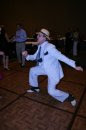
I thought, too, and not for the first time during this long campaign, of Billy Mahone (that's him in the image) and the Readjusters of Virginia, which -- as a third party -- ran the state for a good part of the 1880s on a mandate of readjusting the state's pre-Civil War debt and providing public education and legal reforms the likes of which the state wouldn't experience again until the civil rights era.

Mahone, a former Confederate general and not what one would describe today as a civil libertarian, but more of an opportunist, seized the potential of black working class votes and those of disaffected whites and ran circles around the established Virginia "Bourbon" politicians by actually going out and campaigning.

Mahone unfortunately annoyed people who were allied in his cause by making bad choices, and when the Readjusters were winning, he couldn't actually step further into real progressivism. Basically, the Readjusters controlled the statehouse and the Executive Mansion, they gave some low level patronage jobs to blacks and in fact enacted sweeping reforms the likes of which Virginia had never seen, and sent Mahone to Congress -- and then couldn't figure what to do next.

Then a Democrat-rigged riot in Danville on the eve of a state-wide election shattered the party's chances. Mahone was reviled in Virginia for years afterwards, and building coalitions with blacks was derided as "Mahoneism." (You can read of my fascination with this period here.) What followed was Jim Crow and ultimately Massive Resistance -- neither of which needed to be inevitable, as Mahone shows us.

I had business to attend to; I'd gotten my
Punxsutawney County Pete view of the candidate, and needed to get along.

Afterward, I got a bus back to the office and as we lumbered up Broad Street, the event's attenders streamed along the sidewalks and filled the bus. The only comparison I have to the sensation was riding in a New York subway after an anti-Iraq and Bush rally some three years ago. There, the buttons and banners proclaiming opposition to both seemed somewhat desperate and hopeless, and the mood of the riders united by their adversity, but vexed and angry.

Here, on this Richmond city bus, I couldn't help but be affected by the exhilaration and outright joy among the riders. Most had taken a long lunch from work, and many hadn't seen him speak while others in excited voices spoke about his appearance to those standing outside. A clever political move, by BHO, and actually kind of decent.

Now I don't know how this is going to turn out. I know the defeat of one or the other is going to cause gnashing of teeth and wrenting of garments among the extremists of either side. And that more and more this feels like 1860, and how then, as Dr. Ed Ayres pointed out in a talk given some days ago, few foresaw that within a year the nation would be plunged into civil war.

Or how, when a well-known Virginia political analyst at a recent talk announced to a West End Richmond woman's club that they'd need to get used to a black president, he was booed, and at the end of his talk, the chair woman said to him curtly, "You can find the door."

Those women were never going to vote for Obama, or if so, they'd not admit of their choice to anybody they knew. But as my friend Bill explained to me, they've always had a comfortable Democrat or a comfortable Republican for whom to vote. Now, their world is on a verge of a possible shift and they can't get their heads around that concept.

I don't think the potential alteration of the status quo going to be as radical as anybody thinks -- BHO is a politician, he came out of a rough and tumble big city political machine; he has ambitions, he has made compromises. But should he be elected, Obama will cause a shift in the nation's political currents, and that's the minimum I can expect: a seasonal change in the weather.

For other accounts of the Visitation, you can read Amy Biegelsen of Style Weekly recounting the event and the political strange-bedfellowsness of those standing near the speaker's platform here; blogger Jason Guard biked to the rally and got inside, and experienced the power of the moment, here; a Washington Post perspective here; for what he actually said, the Obama-Biden campaign provides here.

A postscript: on CSPAN this a.m. I caught a brief part of a segment devoted to the viability of Third Party candidates -- there is a debate at 9 p.m. tonight between Ralph Nader and Chuck Baldwin of the Constitution Party. Don't know why the Libertarians aren't participating, with Bob Barr, except that characteristic of Libertarians who expend a great deal of energy fighting among themselves, there are numbers of them who just don't like Barr.

Anyway, the callers I heard were typical. One woman from Tennessee sounded so stereotypical and right wing, quoting scripture, and just shy of calling Obama the anti-Christ said two choices were her preference as though a third party wouldn't really be a alternative; another caller wondered a third party would help or hurt Obama, and another complained of trying to register with the Reform Party in Maryland and getting told the Reformists weren't legal -- a problem common to third parties. And so it goes. In a nation of 300 millions, perhaps more diverse now than ever in our history, we are down to these dual opportunities for not much to really change. To me, this is a shabby way to run a republic.

People will hold their nose with one hand and touch a screen with the other, in states where Third Parties are represented they may get a vote or two thrown their way, and still millions of potential voters just won't cast a vote because of resignation, disgustm apathy, or just out of plain cussedness, as my Goochland County relatives might say. So it comes down to a narrowing margin, and rhetoric, and emotionalism, and the potential for things to go awry.

For me, what it comes down to is three little words: Supreme Court justices. The next president may get to select three justices. And I know whom I'd trust to make those appointments.

These are historic times; which means they are easier to read about in the comfort of some window nook seat, than they are to live through.


Labels: , , , , , , , , , , ,

Thursday, October 02, 2008

Where's Matthew Lesko when you need him?
Uncle Sam should be wearing the question-mark suit

Dressed as Uncle Sam, Miko Sloper holds a sign that reads "No Bailout" while standing in front of the U.S. Capitol October 1, 2008 in Washington, DC. Later, the U.S. Senate voted on a revised version of the financial rescue plan that failed to pass in the House of Representatives on September 29. (Photo by Mark Wilson/Getty Images North America) via Zimbio.com.


You know Matthew Lesko because you've been annoyed by him. His infomercials have popped up at odd hours in the middle of your movie or comedy show for years. He's the question mark guy who wants you to find ways to have the government pay you to open an ice cream store, or go mountain climbing, and so forth.

Well, now, all of Wall Street is going the Lesko route. See his version of the economic stimulus package here.

You can otherwise see him do his thing, here.

This is what it has coming to: hucksterism has eaten its own head and swallowed the country whole.

And so we've come to the vaunted Biden-Palin debate, in a rigged set up bought and paid for by the corporate-owned Presidentail Debates Commission, which sounds like a quasi-government office, but isn't. Wonder why you don't hear about the non-partisan, non-profit League of Women Voters anymore?

The debates aren't debates. They are informercials -- just like Lesko.

Quoting Fred Barnes from (of all places) the Weekly Standard online...

"There aren’t many outfits as arrogant, self-important, and aggrandizing as the unelected Commission on Presidential Debates (CPD), sponsor of tonight’s debate between Barack Obama and John McCain. When John McCain said Wednesday the debate might have to be delayed so he could work on the financial bailout, the commission responded, in effect, “Sorry, John, the debate must go on, whether or not financial markets collapse. The debate is more important.”

That was just the latest example of high-handedness by the commission, which has hijacked the debates from the candidates, the campaigns, and the news media. The commission picked the sites for the debates (three presidential, one vice presidential) and charged the colleges involved $1.5 million for the honor. Then CPD announced the moderators for each debate without consulting with Obama or McCain campaigns or even informing them ahead of time.

>>>>>>>>>>>>>>>>>>>>>>>>>>>>>>>>>>>>>>>>>>>>>>>>>>>>>>>>>>>>

The CPB took over the debates in 1987 after the League of Women Voters was sacked as the sponsor. The league had often irritated the campaigns, especially the campaign of President Carter in 1980. Carter aides privately mocked the league as “the plague of women voters” and “the league of women vultures.”

The commission ran the show in 1988, 1992, 1996, 2000, and 2004. One of the biggest complaints this year was the selection of sites in Mississippi, Tennessee, and New York--not battleground states..."


Or, from the opposite extreme, Ralph Nader:


"The debates are controlled by the so-called Commission on Presidential Debates, a private corporation which was created by the Democratic and Republican Parties in 1987.

The Commission is headed by Frank Fahrenkopf -- the former head of the Republican National Committee, and Paul Kirk -- the former head of Democratic National Committee.

Fahrenkopf is a lobbyist for gambling interests, Kirk for pharmaceutical companies.

Debate sponsors have included Anheuser-Busch, Phillip Morris, Ford Motor Co., Yahoo Inc., 3Com, among other companies who gave soft money to the two parties’ national committees.

In 2000, some in the press dubbed the debates as the “Anheuser-Bush-Gore” debates.

In a memo by the CPD, the avowed goal for forming the commission was to "strengthen the two parties."

In 1988, the Commission seized control of the debates from the League of Women Voters.

The League had a history of allowing third party candidates to participate in the debates. In 1980 the League invited Congressman John Anderson to join Jimmy Carter and Ronald Reagan in the debates.

Anderson was given a boost from the public debates. At one point the polls had him at 21%. He won 7% of the vote."

You can read more here.


Snagged from The Daily Pitchfork.

One Good Aspect of Financial Crisis News Reporting


This is Michelle Caruso-Cabrera who reports on money matters for CNBC. Say her name soft, and it's like purring, say it aloud, and it's like proclaiming love for a Latinate poet.

Here she is, wearing red, in the hope of attracting a bull market.

Watching her explain complicated market gyrations in her exuberant and illustrative manner reminds me of having a debate with this girl you with whom somehow you managed to finesse a date but won't be able to keep dating because she's going places you're not. There would be a pitcher of beer, and she should be explaining in terms you could understand complicated financial matters while gesturing with a chip full of nachos. You just love watching especially when she's all fired up with a topic for which she possesses such passion and knowledge.

She's much better looking than that bald, bearded yelling guy, and probably knows more, too. And, below, giving us the business. Both images from reportercaps.


Labels: , , , , , , , ,

Wednesday, July 02, 2008

Scylla and Charibdis
Either government doesn't matter, or that's all that matters. I don't know which.


I'm really wishing I had a poster version of this fantastical, post-collapse illustration of a road trip. And I wish I could be responsible and tell you a) the artist and b) where I got it. I've had this for awhile and just slugged the title as "Road Trip2" and a search for this didn't turn up the picture. If anybody knows where or how to credit this, say so.


Should I Go To Monterrey And Watch The Whales?

About two weeks ago Amy Goodman had Ralph Nader on Democracy Now! He was also profiled by Paul Farhi for the Washington Post, because, yes, he's running for president again.

From Farhi:

"So at 74, shunned and marginalized, he's running for president for the fifth time.

"It's the rational approach," he declares. "If you're locked out of the governmental system, if you can't get a hearing, and I can't, you go to the electoral system. What's my alternative? Should I go to Monterey and watch the whales?"

Having burned so many bridges, and persuaded for decades in the righteousness of his cause, Nader insists not on harnessing his dwindling sympathizers to the current Obama Hope train but instead takes every opportunity to drub Obama about how he's really just another suit. And Nader could be right.

Obama must run as a centrist candidate--much as Doug Wilder did when running for Lieutenant Governor and Governor here in Virginia, and what he sought to do when he ran for President for 10 minutes in 1993. This is the same reason Colin Powell was bruited for one executive office or another; but frankly, I don't know if Powell--one-- has the stomach for the fol-de-rol of campaigning and, two, with the way he was trotted out to fall on his sword for a lying administration, if he wonders himself what the hell he built a career in the military fighting for. Or maybe I'm naive. The latter is the most possible.

My gullible nature notwithstanding, if Obama ran as big a liberal as he likely is, there's no way he'd turn out the votes he needs. He's got a tough enough time being black and half-white and not Muslim. Politics is politics. Nader must know that.

I once met Nader, prior to his 2000 bid that made so many people angry. He was speaking at a philanthropy conference and I had the opportunity to interview him for a publication. We were backstage at a brand spanking new performing arts center at the University of Richmond. With a straight face, the only one he owns, he worried whether the blown-in insulation above us was asbestos. I got anxious because the little table upon which I rested my notepad wiggled and that caused the small lamp on it to flutter, with an obvious electrical short. I thought better of this, and rested the pad on my knees.

I remember how in 2004 Michael Moore and Bill Maher got down on their knees to beg Ralph not to run. The former Canadian Prime Minister Kim Campbell -- who always made the best points on the shows she was on -- makes the point that Nader changed the way people throughout the world think about power. And said then he could be out there as the gadfly mobilizing people. He could be part of a feet-to-the-fire campaign. Use a check list, and f a candidate doesn't do it he pays the price. If Nader helped somebody win, he's still a player, and has influence where influence is everything.

Nader didn't take her wise advice. He's got his own reasons.


From the Post feature:

"Todd Gitlin, a Columbia University professor and a liberal author, admits he becomes "splenetic" on the subject of Nader the candidate. "I regard him as a saboteur of the cause to which he purports to devote himself," Gitlin says. "Nobody I can think of in public life has so willfully repealed his contributions to American life with such intensity and conviction."

Eric Alterman, another liberal commentator and author, calls Nader "a megalomaniac" and "a Leninist," in the sense of Nader's belief that things must get much worse before reform can begin. "There was only one person in entire world on election eve who could have prevented Bush's election."

Nader doesn't feel a need to apologize. He doesn't worry that the first line of his obituary will describe him as the spoiler of the 2000 race. He often quips, "You can't spoil a system that's rotten to the core." To strangers who get in his face, he has another deflection: "Gore won. The election was stolen. Go after the thieves."

It wasn't his responsibility, he says, to persuade people to vote for Gore. If voters were attracted by his positions and issues, he says, then Democrats were free to take the same positions. Bottom line? "The Democrats couldn't beat a bumbling governor from Texas," Nader mocks.

Nader wasn't the only man who could have changed the election's outcome. His name was one of eight third-party candidates on the Florida ballot, all of whom attracted far more than the 538 votes Gore needed to change the outcome.

Nader thinks it's futile to keep arguing about it. He also thinks one man could stop the "scapegoating": Gore. "If he would stand up and say publicly, 'Ralph Nader wasn't responsible,' that would make a huge difference," Nader says."


Nader: Obama Is Running For "Panderer-in-Chief"

From Democracy Now!:

AMY GOODMAN: Ralph Nader, on his first day as the Democrats’ presumptive nominee, Barack Obama traveled to Washington to address AIPAC, the American Israel Public Affairs Committee. This is some of what he had to say.

    SEN. BARACK OBAMA: Let me be clear. Israel’s security is sacrosanct. It is non-negotiable. The Palestinians need a state—the Palestinians need a state that is contiguous and cohesive and that allows them to prosper, but any agreement with the Palestinian people must preserve Israel’s identity as a Jewish state, with secure, recognized, defensible borders. And Jerusalem will remain the capital of Israel, and it must remain undivided.

AMY GOODMAN: Obama later appeared to backtrack on his comments about the future status of Jerusalem as capital in a follow-up interview on CNN. He said it would be up to the Israelis and Palestinians to negotiate. Ralph Nader?

RALPH NADER: Well, I think Barack Obama is in training to become panderer-in-chief. That was really a disgraceful speech. It didn’t further the peace process, the two-state solution favored by a majority of Jewish Americans, Arab Americans, a majority of Israeli and Palestinian people. He basically sided with the militaristic approach to occupying, repressing, colonizing, destroying the Palestinian people in the West Bank and Gaza. He hasn’t even spoken out against the international crime of the blockade of Gaza, one-and-a-half million people, from medicine or drinking water, fuel, electricity, food—lots of silent fatalities in Gaza because of that.

Barack Obama really now has to be examined very carefully. He has worn out the word “change.” We now want to know what change is involved. And it’s quite clear that he is a corporate candidate from A to Z. In his voting record, he voted against reform of the Mining Act of 1872, which gives away our hard rock minerals. He voted for a terrible class-action restriction law that the corporations wanted him to vote for. He, in many ways, has disappointed people who had greater hopes for him. He’s voted for reauthorizing the PATRIOT Act. He refuses to even discuss—he’s vigorously against impeachment of Bush and Cheney. He won’t even support his colleague Senator Russ Feingold motion to censure the Bush administration for systemic repeated illegal wiretaps. He—you know, he’s letting the corporate-dominated city of Washington, the corporations who actually rule us now in Washington, determine his agenda. And that does not augur well.

He’s just appointed economic advisers right out of the Robert Rubin school of Citigroup and the University of Chicago. His Middle East advisers involve people who actually helped write his AIPAC speech. You know, it’s a sad thing to see, because he knows better, but he’s suppressing himself repeatedly until he becomes a different person, should he be elected president.
.............................

AMY GOODMAN: Ralph Nader, I wanted to play for you two clips, one of Barack Obama and one of McCain. This is Barack Obama speaking about Iran.

    SEN. BARACK OBAMA: We will also use all elements of American power to pressure Iran. I will do everything in my power to prevent Iran from obtaining a nuclear weapon. Everything in my power to prevent Iran from obtaining a nuclear weapon. Everything.

AMY GOODMAN: On the campaign trail, John McCain accused Obama of being naive on Iran.

    SEN. JOHN McCAIN: My friends, they are developing nuclear weapons. Also what is totally unsatisfactory is that the Iranians are making, are manufacturing and shipping into Iraq the most lethal explosive devices that are killing young Americans. That’s not acceptable. And Senator Obama wants to sit down without any precondition across the table and negotiate with this individual. My friends, that’s not right, and that’s naive. And that shows a lack of experience and a lack of judgment.

AMY GOODMAN: McCain’s position and then your assessment of Obama?

RALPH NADER: Well, it recalls Michael Abramowitz in the Washington Post in March and New York Times reporters a few weeks later saying that if Obama or Clinton were elected president, the foreign and military policy would not be much different than the foreign and military policy of George Bush in his second term. And that illustrates that. The military-industrial complex and the politicians like Obama and McCain who support it—$700 billion, over half of the federal government’s operating expenditure now is the military budget—are desperately looking for enemies, desperately exaggerating enemies.

Iran has not invaded anybody in 250 years. Yet it’s obviously frightened. It’s surrounded by the US military west, south, east. It’s been labeled “Axis of Evil” by Bush, who invaded Iraq after he labeled them “Axis of Evil.” We have Special Forces, according to Sy Hersh, that go in and out of Iran. What are they going to do? They talk very belligerently nationally, but they’re really scared. I mean, we supported Saddam Hussein, logistically and with materiel, in invading Iran, which took a half a million Iranian lives. They remember the shooting down of their civilian airliner years ago."


Theodor van Thulden - Sirens, Scylla and Charibdis, 17th century via, orrologion.


I admire communal and even anarchic principles and can see how they may work in small communities where the consent of the governed, or un-governed as they case may be, is easy to gauge. But with a nation of 300 millions, spread over a continent, there is little real way of maintaining a democratic relationship forever without periodic renovations of the structure. And that happens every, oh, 200 years or so.

Am I just throwing up my hands, and therefore saying; OK, you win, bring on the despot? Or am I saying: I am a concerned citizen, but I have too much going on in my life, with an accumulation of interests and a good group of friends and colleagues, to allow my precious life moments to get siphoned off in the affairs of national government that is beyond repair. On a street and even block level, this is where when I have the emotional energy spare on such matters. I mean, at this point, I don't see any other way to retain my balance.

Obama can give no speech and Olbermann can make no Special Comment that'll save us.

"Hope And Fear Chase Each Other's Tails"


I'll keep voting, though I feel that beyond the local level, it doesn't matter much.

Jim Kunstler's Clusterfuck Nation isn't the place to go for cheerful news, usually, but I do on occasion run into somebody who has written thoughts I harbor but haven't articulated. As in here, with Djinn:

"All this talk about the presidential election, and candidates and their stated policies, underlines an emerging situation that people have yet to get their heads around: IMHO politics and the political structure in the US have already proved themselves ideologically and intellectually irrelevant, and I think they are about to become manifestly irrelevant.

Government is structured in such a way that sound and sensible policy decisions are politically impossible. Besides that, not that many of the problems we face can be addressed using the political machinery, even if there was any will to address them. We are looking down the barrel of something that government simply can't do anything about. We can be sure that government will perform its customary function of implementing policies so misguided as to assure that the coming catastrophe is as catastrophic as possible."

No Hope In Hope


Djinn also gave an extensive excerpt from activist Derrick Jensen, author of A Language Older Than Words and The Culture of Make Believe. This piece came from Endgame, published in June 2006 by Seven Stories Press, and is about how Jensen gave up on hope. Things are bad, and getting worse, and hoping something will intervene is, well, he says, folly. I've truncated it, but you can see it all here.

"Frankly, I don’t have much hope. But I think that’s a good thing. Hope is what keeps us chained to the system, the conglomerate of people and ideas and ideals that is causing the destruction of the Earth.

To start, there is the false hope that suddenly somehow the system may inexplicably change. Or technology will save us. Or the Great Mother. Or beings from Alpha Centauri. Or Jesus Christ. Or Santa Claus. All of these false hopes lead to inaction, or at least to ineffectiveness. One reason my mother stayed with my abusive father was that there were no battered women’s shelters in the ‘50s and ‘60s, but another was her false hope that he would change. False hopes bind us to unlivable situations, and blind us to real possibilities.

Does anyone really believe that Weyerhaeuser is going to stop deforesting because we ask nicely? Does anyone really believe that Monsanto will stop Monsantoing because we ask nicely? If only we get a Democrat in the White House, things will be okay. If only we pass this or that piece of legislation, things will be okay. If only we defeat this or that piece of legislation, things will be okay. Nonsense. Things will not be okay. They are already not okay, and they’re getting worse. Rapidly.....We’ve all been taught that hope in some future condition—like hope in some future heaven—is and must be our refuge in current sorrow.

...I’m sure you remember the story of Pandora. She was given a tightly sealed box and was told never to open it. But, being curious, she did, and out flew plagues, sorrow, and mischief, probably not in that order. Too late she clamped down the lid. Only one thing remained in the box: hope. Hope, the story goes, was the only good the casket held among many evils, and it remains to this day mankind’s sole comfort in misfortune.

The more I understand hope, the more I realize that all along it deserved to be in the box with the plagues, sorrow, and mischief; that it serves the needs of those in power as surely as belief in a distant heaven; that hope is really nothing more than a secular way of keeping us in line.

Hope is, in fact, a curse, a bane. I say this not only because of the lovely Buddhist saying “Hope and fear chase each other’s tails,” not only because hope leads us away from the present, away from who and where we are right now and toward some imaginary future state. I say this because of what hope is.

...

PEOPLE SOMETIMES ASK ME, “If things are so bad, why don’t you just kill yourself?” The answer is that life is really, really good. I am a complex enough being that I can hold in my heart the understanding that we are really, really fucked, and at the same time that life is really, really good. I am full of rage, sorrow, joy, love, hate, despair, happiness, satisfaction, dissatisfaction, and a thousand other feelings. We are really fucked. Life is still really good.

Many people are afraid to feel despair. They fear that if they allow themselves to perceive how desperate our situation really is, they must then be perpetually miserable. They forget that it is possible to feel many things at once. They also forget that despair is an entirely appropriate response to a desperate situation. Many people probably also fear that if they allow themselves to perceive how desperate things are, they may be forced to do something about it.

Another question people sometimes ask me is, “If things are so bad, why don’t you just party?” Well, the first answer is that I don’t really like to party. The second is that I’m already having a great deal of fun. I love my life. I love life. This is true for most activists I know. We are doing what we love, fighting for what (and whom) we love."


One of the aspects I enjoy about this image is the dynamic between these women.
They've stopped to discuss how best to proceed. Should they continue on, or will they be able to make it to the distant and ruinous city (seen in the larger example at the top of this post) before nightfall? Should they even try? What's the best way to proceed? Those cute rucksacks don't appear to be large or lumpy enough to have bedding materials inside--but maybe, if stowed in a neat fashion. Maybe this is a short reconnoitering hike to see what's Beyond The Next Hill before returning to their outpost.

The former highway's surface is cracked and on the verge of getting reclaimed by nature. A busted car is just ahead, crooked jersey barriers, a discarded tire. This is not quite the Yellow brick Road. And, I admit my bias, I have a thing for women in shorts and hiking boots. And I also like that neither of the women appear to have weapons (though I suppose you could smite somebody with that walking stick).

I'd like to read the story about these intrepid women.


Labels: , , , , , , , , , ,

Sunday, February 10, 2008

I Want The West Wing; Not The Same Old Thing
Richmond's Obamagasm --- But what if none of this matters?

Barack Obama, Hillary Clinton and even Ralph Nader were in the 804
this past weekend. [Image via Reuters and the Spiegel Magazine site.]

Barack, HillnBill, all this and Chinese New Year's, too.

This was one of those moments when Richmond appeared to be in the middle of something Important. The Jefferson Jackson event (that's as in past presidents Thomas and Andrew, not Jefferson Davis or "Stonewall" Jackson) at the Virginia Commonwealth University's Siegel Center on Saturday night brought to the podium Sen. Hillary Rodham Clinton and Sen. Barack Hussein Obama.

I've been so caught up in rummaging about in events of 1909 that I didn't realize that we groundlings could've paid $35 and heard them both speak. The seats were in the rafters, but that would've been OK to get a glimpse at History In The Making.

Meanwhile, there was a tangential connection to this political season's visitation to Broad Street. Both camps had sought venues within walking distance of the speechifying. The Obama contingent set up a big screen TV to track the primary action, and the JJ dinner. They were smart to also feature the rollicking No BS Brass Band and the toe-tapping wayback-stylings of a group whose name I couldn't ever get straight-- Above Depression or Beyond Depression -- fronted by the wonderful Margaret Fleischman.

Unbeknownst to me, Bill Clinton spoke for about 45 minutes down at the Greater Richmond Convention Center. I was aware, however, that Hillary had chosen to use the Firehouse for a gathering with about 50 supporters. Carol Piersol, with whom I co-founded the place with three others 15 years ago, called at work on Friday to give me the news. Would I be interested in coming down Saturday afternoon to hang some of our framed pictures for the sake of appearances?

But our indispensable Melissa G. got to business right away; put together gift bags and contacted installation/sculptor artist David Turner to install his show that's supposed to go up for Henry Moss. Tad Burrell and Stephen Harris assisted in getting the place straightened up; Saturday afternoon I picked up debris of various kinds in the less than pristine rear parking courtyard behind the Firehouse. Hillary was getting brought in from the alley.

The security people wanted minimal staff, meaning Carol got to meet Hillary, and me and Amie couldn't, nor, to be honest, could any other members of the Firehouse organization. This wasn't a social occasion for HRC, but a business one. She needed to make a sales pitch to these people.

When returning home from my little effort at the Firehouse I came upon a friend stopped in his old Alfa Romeo at an intersection. The day was pristine and perfect for riding around in a convertible sports car, and he gave me a lift. I burbled about my Hillary news and this good man, an self-employed business person who operates a garage that specializes in maintaining and repairing oddball and vintage automobiles, shook his head. Since John Edwards is out of the race, he doesn't know who he can vote for.

I have to agree with Bill Maher, too, that at their most recent debate, Obama and Hillary looked like a local television station's weekend news anchor duo.

One Firehouse comrade who ambled in after HRC's departure, whom we met on the sidewalk, kind of summed up the evening's mood. He glanced at the activity at The Camel. "I'd rather be here, anyway," he said, and gestured behind him, "That's the past, this is the future. And this demographic is a bit more to my liking." The Obamian United Colors of Benetton wasn't similar to the Firehouse gathering, reported our friend. They were ladies of a certain age, who were rallying around HRC's banner to prevent further drooping. "I didn't know there were that many wealthy Democratic women in Richmond," he said. "But I guess they came from all over the state."

We stood and watched Obama's speech broadcast on the large screen and this was quite enjoyable. Around me, all kinds of folks, their heads chin-raised to see, their expressions eager and energized, clung to his words. There was applause and cheering and chanting of "Yes we can!" Amie was impressed because of all these political speeches we've heard of late, Obama's was the only one in which art and music got a mention. Not just a passing nod, but given with a sense of importance to cultural fabric. So much is heard of statistics and wages earned and billions spent, so this was noticeable.

And as he spoke, the screen ticker announced that his campaign had on this day emerged victorious in Washington, Nebraska (!) and Louisiana. This generated greater excitement and no movie could've added such additional drama. But among the faifthful gathered came much furtive discussion about the numbers and meanings of "super delegates." The mandarin mystique of these greater-than-equal delegates is the embodiment of the many ways the Democrats manufacture to shoot themselves in the head as a party. And the existence of such creatures is about as undemocratic as you can get.

But speaking of the audacity of hope:
amid these Obama disciples I bumped into an old friend of mine, Jim, from the Richmond Review days, who wore with pride his Hillary Clinton button. He was circled by several women who were urging him to see the matter their way. This encounter exhibits the difficulty of being a Democrat this February; the supporters of one candidate don't want to disrespect the supporters of the other. So there are these urgent and for the most part good-natured conversations in which the subject comes around to: which of the two is better qualified to go at it against McCain, and with voting margins so narrow in many national contests?

I think Jim is a contrarian, though he claimed to me his display was genuine: the whole "experience" thing. Oh, sigh. Like I told him, my desire is for a different set of problems, and not Clintonian baggage piled up in front of the White House entrance like Rose Dewitt Bukater's in Titanic. No, not all of that baggage is Hillary's but it is Clintonian, and that alone was enough to almost sink a ship of state.

A number of those in the audience, and others whom I'd run into during this weekend, heard Ralph Nader speak at "The Biggest Picture" environmental film festival at the Byrd Theatre. (I was sorry to miss The Milagro Beanfield War, and Sonia Braga as a greasemonkey in denim. I remember seeing this at the theater when it was new, and me more so, too).

Those who heard Nader seemed to like him, and as as one told me, with a shrug, "He didn't sound leftist -- he just made sense."

I admit to a certain affinity for Nader and his pugnaciousness though I'm not over the role, how little or not, he played in the Gore v. Bush match up. In Style Weekly he explained, "
To those who blame him for Bush, Nader has countered that Gore lost a number of states he should’ve won (such as Tennessee), that social scientists have proved his pushing Gore to the left actually won him more votes and that Gore would have won Florida if not for illegal voter removals perpetrated by Jeb Bush and Katherine Harris (“Either we’re all spoilers of one another … or none of us are,” Nader has said)."

But I think of Nader while reflecting upon standing there with the Obama crowd and feeling their energy and wishing and hoping such emotions would prove infectious. Political journo/blogger Matt Taibbi--whose sardonic cynicism I couldn't live with and write at the same time, which is why I'm not in Rolling Stone--has made the observation that both Obama and Clinton are just "posturing conservatives" though he prefers the Kenyan-Kansan over the other.

Riding home Taibbi's view, one comes to the conclusion that there is no there there at the center of U.S. politics. What occurs in these wretched campaigns is as meaningless as porn. Perhaps the process would better serve the public if the candidates wore NASCAR jackets featuring the logos of the corporations and sponsorships, with size of the badges commensurate to the amount given. Then none of them could hide who is supplying the gas to keep their private jets and media pool vehicles gassed up and ready to go. Let's just get the bad news out there for everyone to see. I mean this is why Dennis Kucinich or Ron Paul aren't going to make much headway. And the oxygen got sucked out of the air John Edwards was trying to breathe.

Richmond has a few Paulists. They've slathered the traffic poles with their "WHO IS RON PAUL?" flyers, and at every public event there seems to be someone raising up a Paulist sign, and I see his name in windows of Fan District apartment buildings. I am friends with a fellow, a lawyer, who was in the U.S. Libertarian party organization when Paul was involved, and my friend got to know him, not well, but enough to see that he was an OK guy. He's no more kooky than anybody else who claims he or she wants the job of President of the United States.

People say they want change-- but really?

The U.S. electorate is, in many cases and with exceptions, docile. We aren't about third candidates. That's just too much work. We aren't marching for revolution -- we've already had one, and George Washington won.

Not much foundation-shifting change is possible because of how the system is rigged. Our founders liked democracy just so far -- the electoral college and the Senate are constant reminders that the national framers feared full participation by the masses at least in equal amount to their hatred of tyrannical whimsy. They tried to set up a system to last in the long term by protecting us from ourselves. They couldn't have foreseen, though, how the rise of mega-corporations and the handmaiden of rampant capitalism would create a nation where 12 different packagings of the same goop with which to wash your hair makes people believe they have real choices.

Our elections, in particular since the time of television, are about rewrapping similar ingredients to pass them off as something different. And 98 percent of incumbent politicians in national and state elections get re-elected. The gerrymandering and reapportionment of districts is one part of the equation to blame; private money and public apathy are the other key components.

How ridiculous is it that in a nation of 300 millions that are choices for nation's figurative leadership comes down to two people. So, yes, I want to cheer and whistle and stomp my feet as my heart lifts to Obama's rhetoric. Except, even if he believes what he says--and I think he probably is convinced in most of his highflown "hope mongering" -- Obama is a mere man, and there's one of him, and he's jumping into the eye of the maelstrom that is Washington D.C. Well, he's got a seat at the edge already. And he wants to stay because he's persuaded of his possessing better methods.

And, tonight, the Democratic voters of Maine...Maine....think so, too.

In Carytown this afternoon, a group of metal-faced, spiky haired 20 somethings were clustering around an Obama campaigner and I overheard one say to the Man from Obama, "We were listening to Hillary last night and it was all God God Jesus God in the first 10 minutes, so we're Obama all the way now."

The young man makes a point. These days, U.S. politicians must refer to the deity or the heavenly hosts with such frequency that you'd think our elections process was on the verge of some ecstatic climax.

So Tuesday is the Crabcake Primaries, Virginia, D.C., and Maryland, and here in Virginia, we don't have to register by party, so, I'm going to amble down to the nearby elementary school to press the button; because, yes, I can.

P.S. I hope eighth blackbird gets all their Grammys tonight. Looks like they've won Best Chamber Music Performance for Strange Imaginary Animals. I don't know if they give a Grammy for Best Playing of A Card Table, but they're winners, in my book.

And Barack won a Grammy for his spoken word rendition of his book.


Labels: , , , , , , , , ,