Memorial Pause

Jeremy Blake (Oct. 4, 1971 -- July 17, 2007 )
Theresa L. Duncan (Oct. 26, 1966 - July 10, 2007)
Theresa Duncan, from a Nov. 21, 2006
post on her blog, The Wit of the Staircase.

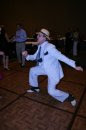
Jeremy Blake pictured at the Vanity Fair opening party for the 8th Annual Art Auction Benefit, "Portraits & Polaroids" held April 23, 2007, at New York City's Milk Gallery. The piece behind him is his Dope & Guns Party. For more on his innovative new media work, see Kinz,Tillou + Feigen.

Theresa Duncan, image from
The Wit of the Staircase entry, January 3, 2006,
"Horror Vacui in Venice," about the fear of empty spaces.
This filigree of quotes and images concerns the second anniversary marking the deaths of artist Jeremy Blake and writer/bloggist Theresa Duncan. I've reprised in part here a post of July 10, 2008.
During the summer of 2007, I fixated on the couple's suicides and their back stories. I wrote a series of interlocking posts called as a group "Seven Kinds of Denial Just to Get Out of Bed." I've noted through recent visits to the Sitemeter that a few people have returned to that series, mostly, I think, to mine the site of Blake-Duncan images. Fair's fair. But what I tried to do then was map "The Blake-Duncan Effect" through the blogosphere. That is, the rounds of speculation, grief, calumny and rank bad taste that metastasized through the Internet in the days and weeks following their demise.
Then, of course, the blogosphere for the most part moved on; to the Xeni Jardin and Violet Blue to-do, and the deaths of Heath Ledger and David Foster Wallace, and, oh, some election thing, and, two wars and economic collapse.
I suppose that it's appropriate that Ellis assay the story, especially considering Glamorama. But William Gibson could equally manage the task, especially in his Pattern Recognition/Spook Country mode. Or even Don DeLillo of Underworld and Cosmopolis.
In the summer of 2007, a number of those within the chattering blogosphere who concerned themselves with matters Blake and Duncan became the thing they beheld. Their attempt to untangle the real/imagined conspiracies against the writer and the artist generated wild speculations. Some of them sounded as nutty as heir subject's latter screeds. It was like at the end of a cable science or history mystery show where there's a screen shot of a field of stars or scary Mayan hieroglyphs and the sonorous announcer says, "Perhaps, really, the more we explore these mysteries, the more we are really delving into ourselves."
The epic lengths of commentary about these deaths proved, too, that in the summer of 2007, members of this eclectic tribe -- "The Children of the Staircase" -- had way too much time on their hands. Including, apparently, and obviously, me. I went from writing about the tears of my wife who mourned the loss of artists to having those same eyes squinted at me and she saying, "Now, you're part of the problem."
Out of all the epic verbiage to which I voluntarily subjected myself, two quotes stand out now, and I've used them more than a few times:
"There exists in the heart of a NYTimes-reading humanities graduate a capacity for nose-upturned covetousness which people don't talk about. It's a horniness for the blessings of another man's life. Not for his health, not for his wife, or for his Ferrari... And not even for the career, exactly, just for the odor of his resume... For his reputation of fulfillment."-- Crid, August 4, 2007, commenting in Amy Alkon’s Advice Goddess blog, to "Making It Up As She Went Along."
"Mental illness is a politically-convenient myth that transposes the cause of destructive behavior away from social constructs and onto the individual. In truth, suicide is not a randomly-occuring chemical imbalance with no external cause (no more so than a malignant tumor metastasizes without prior exposure to carcinogens) but rather the lawful consequence of intelligent organisms struggling to survive in a modern capitalist democracy. The depressed choose to kill themselves because analysis of the data available suggests that to die solves otherwise insoluble problems. If the mental health industry were honest, it would admit that the consequences of freedom are aimlessness and anomie, and that a consequence of the market economy is a lifetime of consumerism culminating in death without meaning. If this life is a hell for some, the world we have inherited is why...Of course, if the mental health industry were honest, nobody would buy their happy drugs anymore; and everybodies [sic.] gotta make a living -right?" -- Manna, on Gawker.com, August 20, 2007.
Then, speaking of native Richmonder Xeni Jardin, there was a New York Times article this past summer about her and the Internets, and concluding with these observations by writer Noam Cohen:
"For all the damage to reputations the Internet can cause, perhaps the greater anxiety from online communication is the weightlessness of it all. The whole World Wide Web can seem like a hall of mirrors — nothing tangible, no binding, no watermarks, no notary public seals. Where, exactly, is it? How do we know any of it is true?Ms. Jardin said she did not sign up for the heaviness of being a publication of record.
“It’s still kind of punk rock,” she said. “The part that still freaks me out is that it is such a huge thing. Part of what people love about Boing Boing is that I can post whatever I want. It’s super fast-moving.” She added: “The huge impact it has, the whole thing that makes it this thing, is that it is so lightweight.”
Yet it seems so important at the time.

From Blake's Reading Ossie Clark, in the Daily Serving, August 27, 2007.


"She is gone, and he is gone, a play set up in the privacy of love, a stage set in the intimacy of public longing for details." —Jonathan Perez, July 26, 2007, “Ode To Jeremy Blake” at The Palm At The End Of The Mind.
"…Whatever interests they may have had, the suicides are not really all that astonishing. I talk to people who have tried it every single working day and the explanations are usually very mundane and sad. As for the “paranoia”, please consider some alternative explanation.
“I think we all want this to be more than it is for a myriad reasons. I think we’re all creative and smart and that means we read into things and enjoy it and our brains work on overdrive. We quickly pass over the obvious or the banal because we assume it has just GOT to be more than what it appears to be; this simply CAN’T be all there is. We want to believe that, so whether we know it or not, we fuel and perpetuate that. I posted once before that I’m sure if I died suddenly or mysteriously, lots of things would come to light about me that people would be surprised of and never knew. We all have skeletons in the closet and things that happen to us on a daily basis that we keep to ourselves. Mystery loves company. Without us, there’d be no wonder, no romance, no crypticism. Right?” — GothamInsider, August 1, 2007, onDreamsEnd, (blog)
“Paired paranoia is particularly pernicious. * SIGH *”
--Scottynuke, Washington Post, August 1, 2007, “Achenblog,”
"But like the best bloggers, she created an illusion of intimacy with her readers. Most blogs are simply unedited confessions for the blogger or for close friends, posted where they might be found by strangers (as, I imagine, the diarist dreads but also desires). And still other bloggers hope for anonymity, only to deliberately push its bounds by revealing too much — when readers know all but one secret, they’ll search for it, and find it." —Swati Pandey, August 1, 2007, Los Angeles Times Opinion Daily.
“Beauty. Brains. Bonkers. The question now is, what the hell was going on in Jeremy Blake's head?” -- August 2, 2007, SoMA: Society of Mutual Autopsy (blog), “Theresa Duncan Upsate.”
“She was bright and polished apple with a rotten core.”
--#15.”Guest” commenting August 4, 2007, Laist, “Staircase to Nowhere.”
"The saddest part of the story is the implication that she may have finally realized that she wasn't special, that she was talented but normal, and rather than see the collapse of her house of lies as an opportunity to finally grow up, she chose to die. What a waste of her creativity and passion."--- from comment by "wf," August 6, 2007, on SLOG, the blog of Seattle, Wash.'s The Stranger alt-weekly, "The Latest on Theresa Duncan"
"Since their suicides last month, the sadly foreshortened life stories of Jeremy Blake and Theresa Duncan have passed beyond their control and are currently passing through the distorted mirrors of projection, grief, anger and a sort of perverse, bicoastal peer review by New Yorkers and Los Angelenos who are stumped as to why a talented and beautiful young artist couple who had been together for 12 years took their own lives, despite seeming to have the grail of professional and personal success firmly in hand."-- August 7, 2007, New York Observer,“Art World Shivers After Lovers’ Double Suicide.”
“The lilly-livered, packaged conclusions that have been drawn about this woman, attempting to do the impossible (explain human complexity in about nine sentences), are falling short of doing anything but making me want to hit someone.” --Alison Tuck, August 7, 2007, Women and Children First, “Dead Artist, Beautiful and Brilliant, Cops Further Beatings” (blog)
“Duncan portrayed herself as a Freudian and a fashionista, an intellectual and a stoner, a political radical with a perfume fetish, and a groupie in a 12-year monogamous relationship. Because of the pliancy of her mind, these seeming contradictions could coexist. She was hungry for knowledge, for answers, for beauty, and she created an online space that was essentially a map of her discovery process -- a "web log" in the truest sense."--
– Steffie Nelson, August 12, 2007, the Los Angeles Times, calendarlive.com
"Just like every other piece on the duo so far, this is about "why" they killed themselves. Not unexpectedly, no one as yet has an "answer." I do! You know why they killed themselves? Because they were fucked in the head. Just like everyone else who's ever killed himelf. Probably not their fault, either—surely the fault of natural chemicals or other chemicals that they put in themselves. Because you know what else is weird? All these profiles talk about how erratic the twosome became—they were paranoid,convincedthat the CIA and the Scientologists were out to get them, erratic with friends.... You know whatthat sounds like? Hi, crystal meth. They sound like everyone who's ever done a lot of stimulants; tinfoil on the windows, water glass to the door, looking for secret cameras. Lots of those folks do themselves in too."-- Choire,August 20, 2007, Gawker.com, suicide is painless"Why Did Theresa Duncan and Jeremy Blake Commit Suicide?"
Labels: Bret Easton Ellis, Don DeLillo, Jeremy Blake, Theresa Duncan, Vanity Fair, William Gibson, Wit of the Staircase, Xeni Jardin
posted by HEK @ 5:00 AM
11 comments